A live demonstration of the Magellan Robotic System performed by Baptist Cardiac & Vascular Institute of Florida.
To learn more about the Magellan visit www.hansenmedical.com
Transcript (partial):
Transcript (partial):
Marty: -- The extraordinary group from Baptist Cardiac & Vascular Institute in Miami, Florida, lead by a very close personal friend, Barry Katzen, but his terrific team, who are going to be the first live case site in the main arena this afternoon,.
Dr. Katzen: Good afternoon, Marty.
Marty: Barry, welcome to the main arena. It's always good to see you. And in the past I've accused you of wearing a Turkish yamulke.
Dr. Katzen: Not today. We're happy to be celebrating the 25th anniversary of TCT. What an incredible session we just heard. The last part, you mentioned team work and we have an incredible team here to share with you an interesting approach and a focus on some teaching points that we'll make in just a moment. To my left is Dr. Libby Watch. Libby is a vascular surgeon who is also trained as an interventional radiologist. I know, Marty, in Columbia, the cardiac community, you have similar types of programs there, and Libby has been a great addition to our group. To her left is Aseem Bhandari, our fellow who is going to share with you the patient history in just a moment. Dr. Tino Peña who's working to my left as well. We'll start off and tell you about this patient and then go into what we were going to try and share with you today.
Dr. Bhandari: Hello everyone. Our patient today is a 69-year-old male, hypertensive, former smoker, whom we've been following over the last seven years for an incidentally detected a aortic aneurysm. The patient is currently asymptomatic with regards to his abdominal aortic aneurysm. Next slide please.
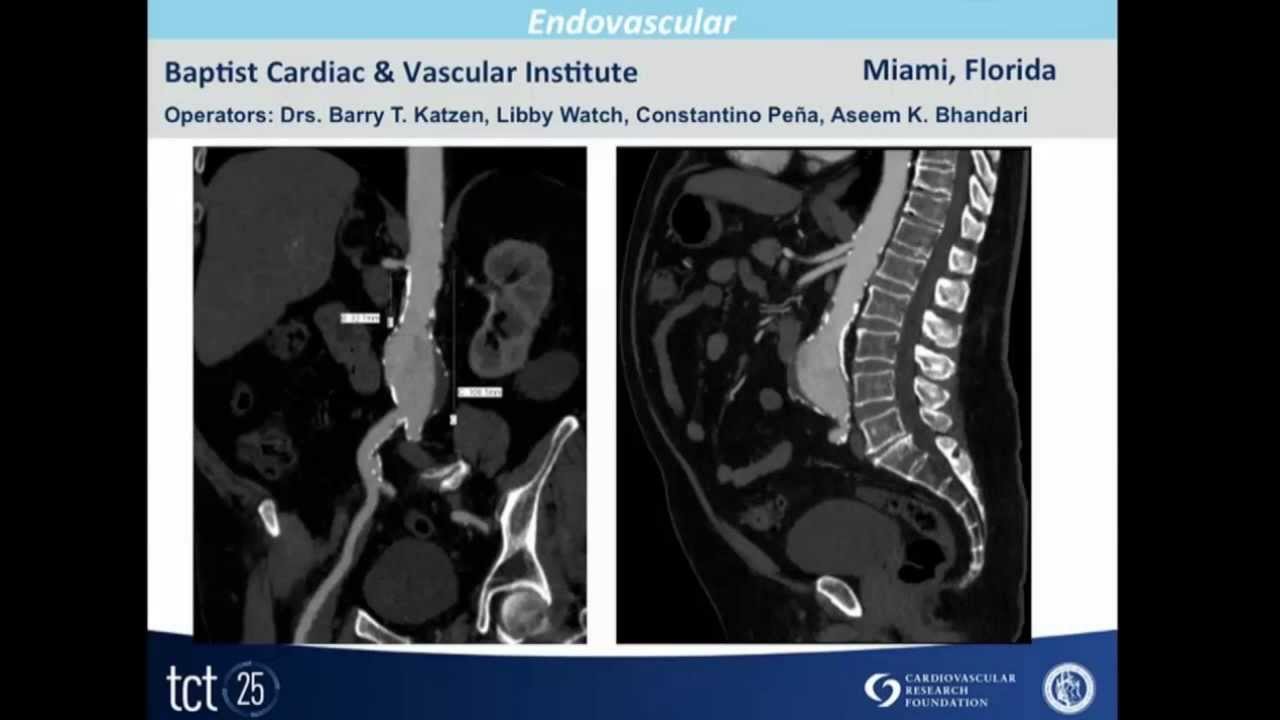
3D volume rendered images and sourced axial CTA images demonstrate the interval growth over the past six months, from 4.9 to 5.5 cm maximum dimension.
Dr. Katzen: Let's just stop here for one second. As you know, we generally provide surveillance to aneurysm patients on an annual basis, but on the image in the middle there, it already started to grow a little bit, so I chose to bring him in for an earlier follow up at six months. That growth is the same status only at six months' time.
Dr. Bhandari: The 3D reformats demonstrate calcific disease of the aorta, and to a lesser degree of the iliac [inaudible 00:03:32]. Next slide please.
Additional represented images from a CTA demonstrate nearly similar origins of the renal arteries, with the right renal artery slightly lower and the proximal landing zone with a diameter of 2.4 cm. Next slide please.
Curved multi-plane RV format images demonstrate an adequate length of the proximal neck with approximately 3 cm. A small amount of mural thrombus is noted within the aneurysm. Next slide please.
Additional curved multi-plane RV format images demonstrate the adequate iliac vessels for endovascular approach. Next slide please.
Here we have a single axial image which demonstrates there is a substantial amount of soft tissue overlying the common femoral artery access site. Next slide please.
So in summary our patient, 69 years old, we've been following him the past seven years. He's demonstrated interval growth greater than 10% over the past year. As we feel in the vascular anatomy, he's amenable to endovascular repair. Our plan today is we performed bilateral surgical cuts down, and we plan on performing endovascular repair robot-assisted.
Dr. Katzen: Marty, it's always a challenge for us to show something of interest to the main arena from the vascular world. We decided to emphasize a couple of things. One is the increasing risk to operators who work more and more in the endovascular and coronary world, from radiation exposure, physical exposure and so on, and how we are addressing that. The other is improving patient safety through practicing and learning more about these complex procedures, whether TAVRs or aortas moving forward. We are going to address those three teaching points.
In this room that we're working on today, we recently installed a new imaging system. It's called Clarity. We're experiencing dose reductions just from changing the system, of somewhere around 50% to 70%. You get right up against the flat detector and our dose aware badges, which we traditionally wear, fail to register anything. So that's one step we've taken to reduce x-ray dose in the environment. We've also reduced frame rates across the board, throughout the institute, which has had the effect of 25% to 30% reduction. Then we are going to talk to you about two other things that we are going to demonstrate today, if I could have the next slide please.

Информация по комментариям в разработке