http://centerforchristianhistory.com
This full-length interview is part of the This Week in Christian History video series produced by the Center for Christian History and hosted by Nick Walters, founder of the Center for Christian History at Mississippi College. These extended conversations are designed to preserve in-depth scholarly insight by allowing subject matter experts the time and space to explain key moments, discoveries, and developments in Christian history with clarity and nuance.
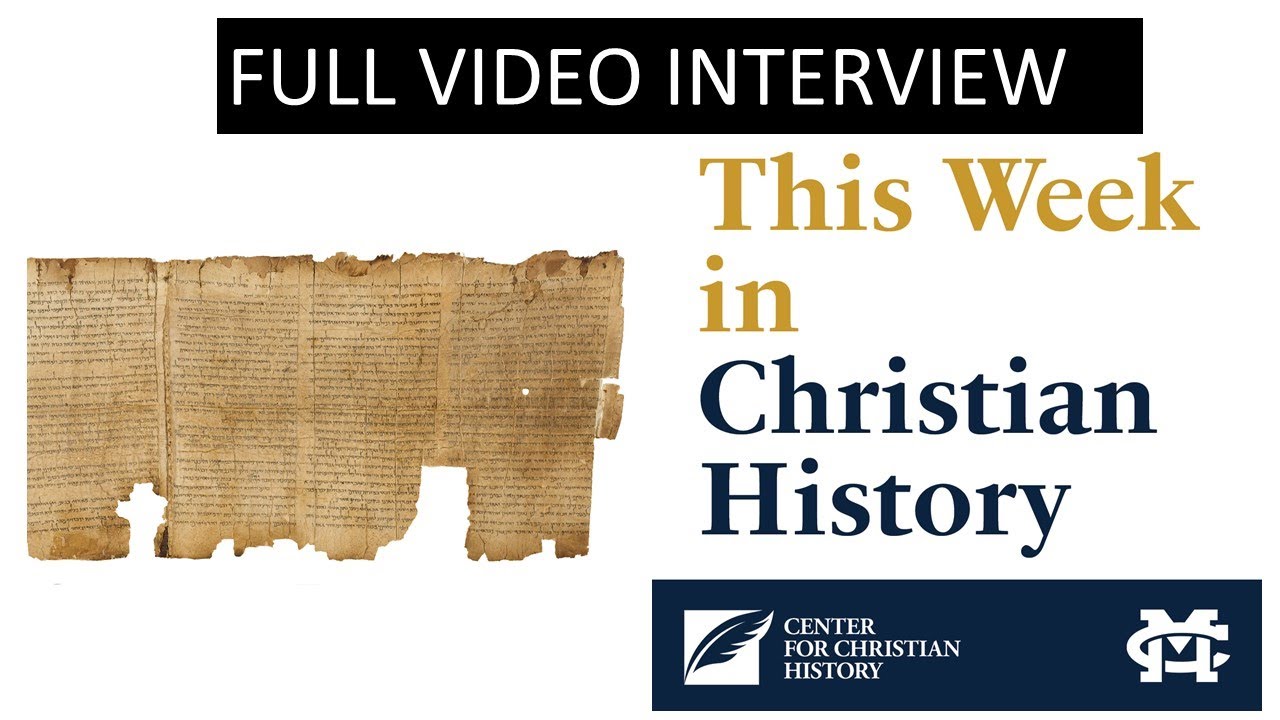
This episode’s interview focuses on the discovery of the Dead Sea Scrolls, one of the most significant archaeological finds of the modern era and a discovery that permanently reshaped the study of the Bible, Second Temple Judaism, and the historical world of early Christianity. Beginning in 1947, a series of discoveries in caves near Qumran along the Dead Sea revealed ancient manuscripts that had been hidden for nearly two thousand years. These texts included copies of Hebrew biblical books, sectarian writings, legal texts, liturgical materials, and commentaries that date from roughly the third century BC to the first century AD.
The Dead Sea Scrolls provided scholars with biblical manuscripts more than a millennium older than those previously available, offering unprecedented insight into the textual transmission of the Hebrew Scriptures. They also revealed the beliefs, practices, and internal debates of Jewish communities living during the period immediately preceding and overlapping the rise of Christianity. As a result, the scrolls continue to play a central role in discussions about Scripture, canon formation, Jewish sectarianism, and the historical context of Jesus and the early church.
The guest for this interview is Robert Duke, Chief Curatorial Officer and Director of the Scholars Initiative. Dr. Duke, often known as Bobby Duke, holds a PhD in Near Eastern Languages and Cultures from the University of California, Los Angeles. His academic training places him at the intersection of biblical studies, ancient languages, and archaeological research, with particular emphasis on the Dead Sea Scrolls and the Qumran community.
Dr. Duke has spent several years living and studying in Jerusalem, including formal study at Jerusalem University College from 1996 to 1998 and at the Hebrew University of Jerusalem from 2000 to 2001 through a Rotary Ambassadorial Scholarship. He also received a competitive fellowship from the W. F. Albright Institute of Archaeological Research in Jerusalem, where he conducted dissertation research focused on Aramaic documents from Qumran. This work placed him in direct engagement with the linguistic and historical materials associated with the scrolls themselves.
In addition to his research credentials, Dr. Duke is a professor at Azusa Pacific University, where he has also served in a variety of senior leadership roles, including Dean of the School of Theology from 2015 to 2021. His teaching and scholarship are marked by a commitment to integrating rigorous academic research with clear communication for students, churches, and the broader public.
In this interview, Dr. Duke explains how the Dead Sea Scrolls were discovered, why the circumstances of their discovery mattered, and how scholars have worked to interpret and preserve them over the decades since. He discusses the contents of the scrolls, their languages, and their relationship to the Hebrew Bible, while also addressing common misconceptions about what the scrolls do and do not say. The conversation highlights why the Dead Sea Scrolls remain essential for understanding the reliability of biblical texts and the religious world in which Christianity emerged.
This extended interview is intended for viewers who want a deeper understanding of the Dead Sea Scrolls and their ongoing significance for biblical scholarship, Christian history, and the study of ancient Judaism.

Информация по комментариям в разработке