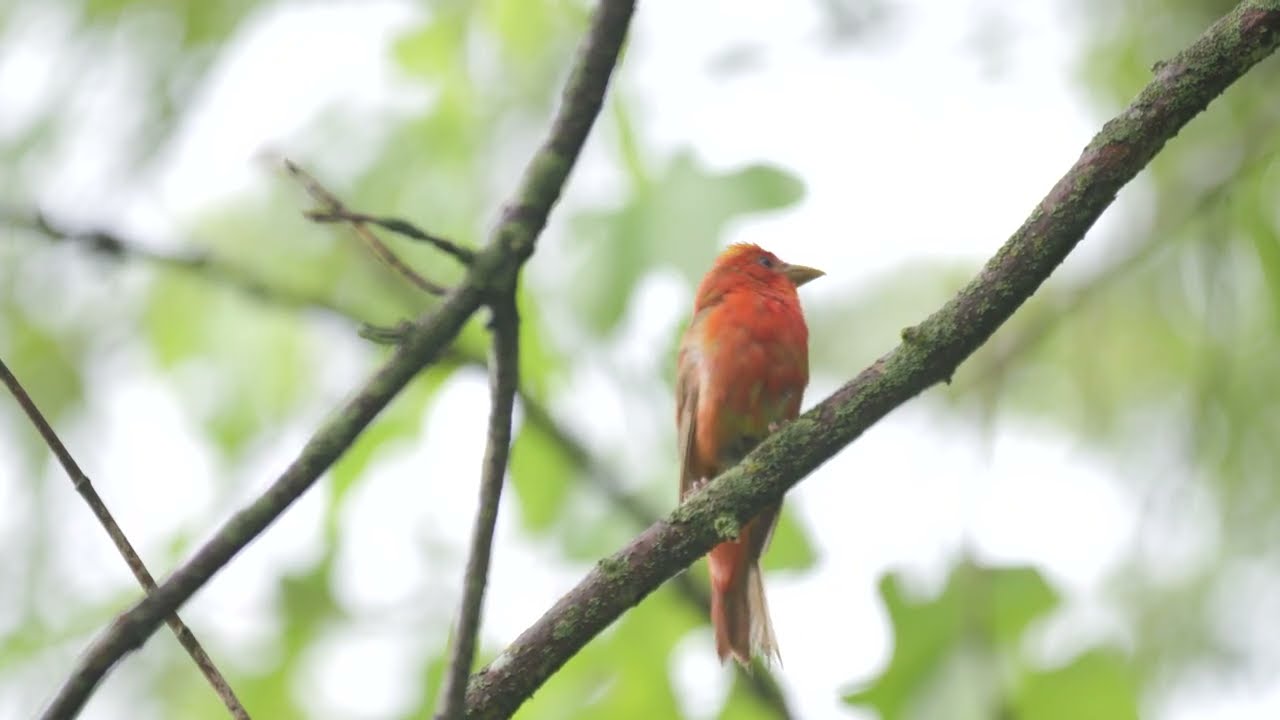
This Summer Tanager is molting after the breeding season. This was a cool and rainy morning when I recorded this video. For more information please read the following and Thank You!
🌞 The Summer Tanager: A Flash of Scarlet in the Canopy
The summer tanager (Piranga rubra) is a striking songbird found across the southern United States during the breeding season, and in Central and South America during winter. Males are unmistakable—cloaked in vibrant, all-over crimson red that glows like a flare against the green canopy. Females and immature birds, by contrast, wear a more subdued palette of yellow-olive tones, with hints of orange or red depending on age and molt stage. This sexual dimorphism not only aids in identification but also plays a role in breeding behavior, with males using their bold coloration to attract mates and defend territories.
Summer tanagers are often found in open woodlands, especially those dominated by oak and pine, and they have a particular fondness for areas near water. Their diet is largely insectivorous, and they’re especially known for their skill in catching bees and wasps mid-air. Remarkably, they often remove the stingers by rubbing the insect against a branch before consuming it—a behavior that showcases their adaptability and intelligence.
🪶 Feathers and Molting: A Seasonal Transformation
Feather structure in summer tanagers is sleek and well-suited for agile flight through dense foliage. The male’s red plumage is the result of carotenoid pigments derived from their diet, which are metabolized and deposited into growing feathers. This means the intensity of their coloration can reflect the quality of their nutrition and overall health.
Molting in summer tanagers typically occurs once a year, following the breeding season. Adults undergo a complete molt in late summer to early fall, replacing worn feathers with fresh ones before migrating south. Juveniles, on the other hand, go through a partial molt in their first summer, gradually transitioning from their olive-yellow juvenile plumage to the more vibrant adult coloration. This molt can result in a patchy appearance, with red feathers emerging unevenly across the body—a fascinating sight for birders tracking their development.
🎶 Vocalizations: A Songbird with a Southern Drawl
The summer tanager’s song is often described as a mellow, melodic series of slurred whistles—somewhat reminiscent of an American robin, but softer and more fluid. Males sing frequently during the breeding season, using their song to establish territory and attract mates. Their call notes include a distinctive pit-ti-tuck or pik-i-tuk, which can sound almost like a hiccup. These calls are used for communication between mates and to signal alarm.
Interestingly, summer tanagers are part of the cardinal family (Cardinalidae), and their vocalizations reflect that lineage. While not as complex or varied as warblers, their songs are still rich and expressive, often delivered from high perches in the canopy. Young males may practice singing in their first year, producing less structured versions of the adult song—a behavior known as subsong, which helps them refine their vocal skills over time.
🧭 Migration: A Long Journey South
Summer tanagers are neotropical migrants, meaning they breed in North America and winter in the tropics. After breeding in the southeastern U.S., parts of the Midwest, and occasionally as far north as southern Pennsylvania, they begin their southward migration in late summer to early fall. Their wintering grounds span from southern Mexico through Central America and into northern South America, including countries like Colombia, Venezuela, and Ecuador.
Migration is typically nocturnal, allowing them to avoid predators and take advantage of cooler temperatures. During this time, they rely heavily on fat reserves built up during the summer, and they may stop at rich feeding grounds along the way to refuel. Their return north in spring is timed with the emergence of insects, ensuring a plentiful food supply for the breeding season.
https://hoosierbird.com/
@hoosier_bird
#Bird Watching #Bird Calls #Bird Songs #Bird Photography #Nature Photography #Birding #Nature Photography

Информация по комментариям в разработке