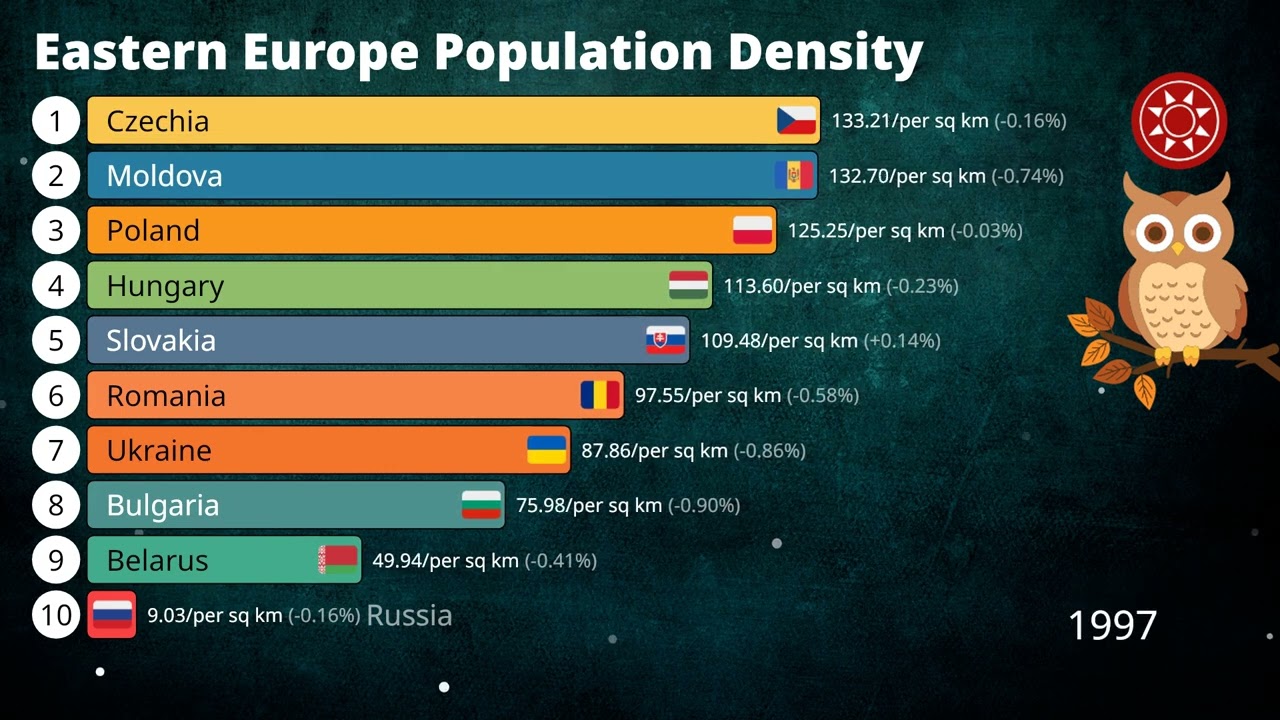
Eastern Europe exhibits a wide range of population densities due to its diverse geography, historical development, and economic conditions. The most densely populated areas are typically in Central and Western parts of the region, particularly in countries like Poland (124 people per km²), the Czech Republic (137 people per km²), and Hungary (105 people per km²). Major cities such as Warsaw, Prague, and Budapest have significantly higher densities, often exceeding 3,000 people per km² in urban centers. By contrast, countries with large rural areas, such as Ukraine (74 people per km²) and Romania (84 people per km²), have lower national averages, with some sparsely populated rural regions falling below 30 people per km².
In the Baltic states and the Balkans, population density varies considerably. Estonia (29 people per km²) and Latvia (30 people per km²) have among the lowest densities in Eastern Europe due to vast forested areas and declining populations. Lithuania, slightly higher at 43 people per km², still experiences significant rural depopulation. In the Balkans, Serbia (92 people per km²) and Albania (100 people per km²) have moderate densities, while Bosnia and Herzegovina is lower at 64 people per km², reflecting its mountainous terrain and post-war demographic shifts. Bulgaria (61 people per km²) has one of the lowest densities in the region, largely due to population decline and urban migration.
The least populated areas in Eastern Europe include northern Russia, Belarus, and certain parts of Ukraine and the Balkans. Russia, which extends into Eastern Europe, has a European population density of around 27 people per km², though this varies widely, with Moscow exceeding 5,000 people per km² while remote areas have fewer than 10 people per km². Belarus, at 46 people per km², has a relatively even distribution but lacks major metropolitan hubs. Ukraine’s eastern and southern regions have seen declining densities due to conflict-related migration. These disparities highlight the complex demographic patterns across Eastern Europe, influenced by urbanization, economic opportunities, and historical factors.

Информация по комментариям в разработке