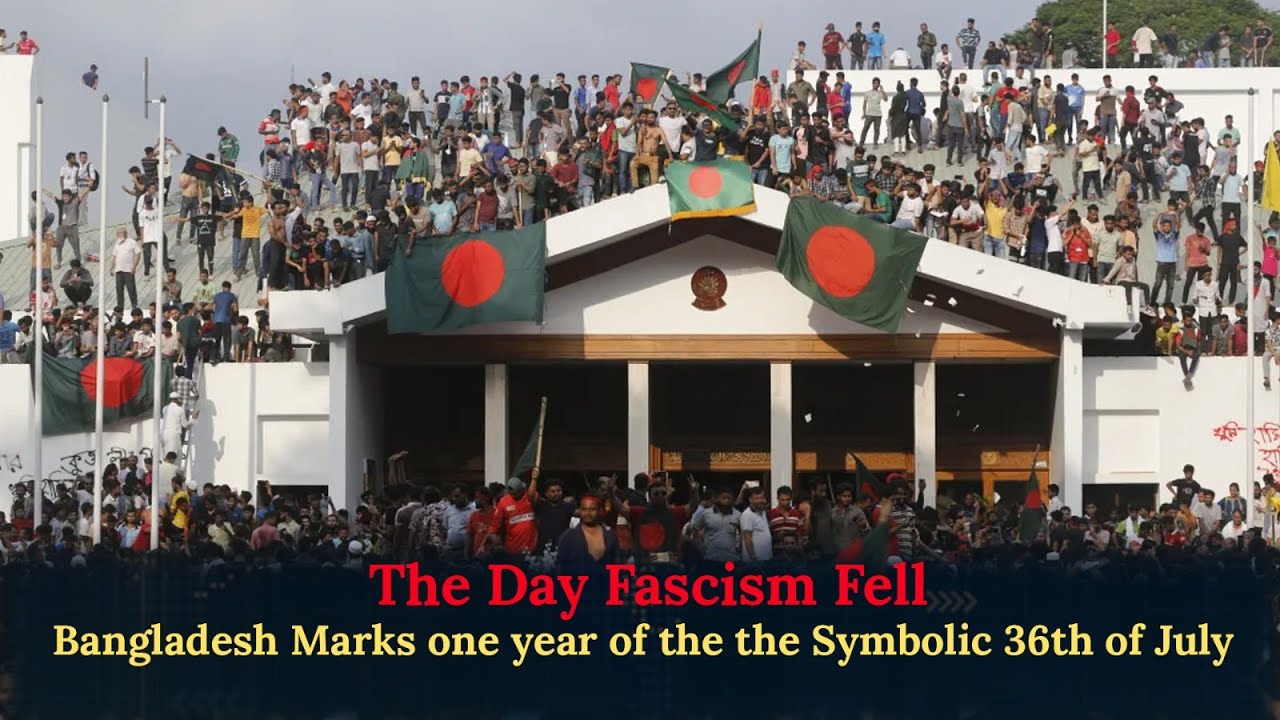
On this day one year ago—August 5, 2024—the people of Bangladesh witnessed the fall of fascism during what became known as the symbolic “36th of July.” Sparked by a controversial court ruling reinstating a 56% quota in government jobs, including 30% for freedom fighter descendants, students across the nation reignited their protests. What began as a demand for justice evolved into a united mass uprising that brought down a 15-year regime. Defying curfews, tear gas, and gunfire, millions joined the historic ‘March to Dhaka,’ gathering at Shahbagh in the early hours of August 5. At midday, Army Chief General Waker-Uz-Zaman confirmed Prime Minister Sheikh Hasina’s resignation and her escape to India alongside her sister Sheikh Rehana. Spontaneous celebrations erupted across the nation. Yet the day also carried tragedy—law enforcement opened fire on crowds, leading to over 1,400 deaths and nearly 20,000 injuries according to UN estimates. In commemoration, events unfolded nationwide: cultural performances, music concerts, speeches, and the official unveiling of the July Declaration at 5 pm by Chief Adviser Professor Muhammad Yunus. In his address, Yunus honored the sacrifices of those injured and killed, condemned the regime’s violent suppression, and pledged to build a humane, democratic Bangladesh. He revealed that Tk 98.4 crore had been distributed to 775 martyr families, Tk 153 crore to over 13,800 injured, and Tk 97.5 crore for treatment—along with free medical care for all affected. Political parties including BNP and Jamaat also held peaceful commemorations, while international partners like the UK, Germany, France, Australia, the EU, and Canada paid tribute and voiced support for Bangladesh’s democratic transition. Musical acts like Artcell, Souls, and Shunno energized the crowds, and a dramatic drone show titled “Do You Miss Me” reminded all of the human cost of tyranny. As Bangladesh marks one year since the day fascism fell, it renews its vow: never again. The 36th of July lives on—not just as a date, but as a symbol of unity, resistance, and the dream of a just, accountable future.
Информация по комментариям в разработке