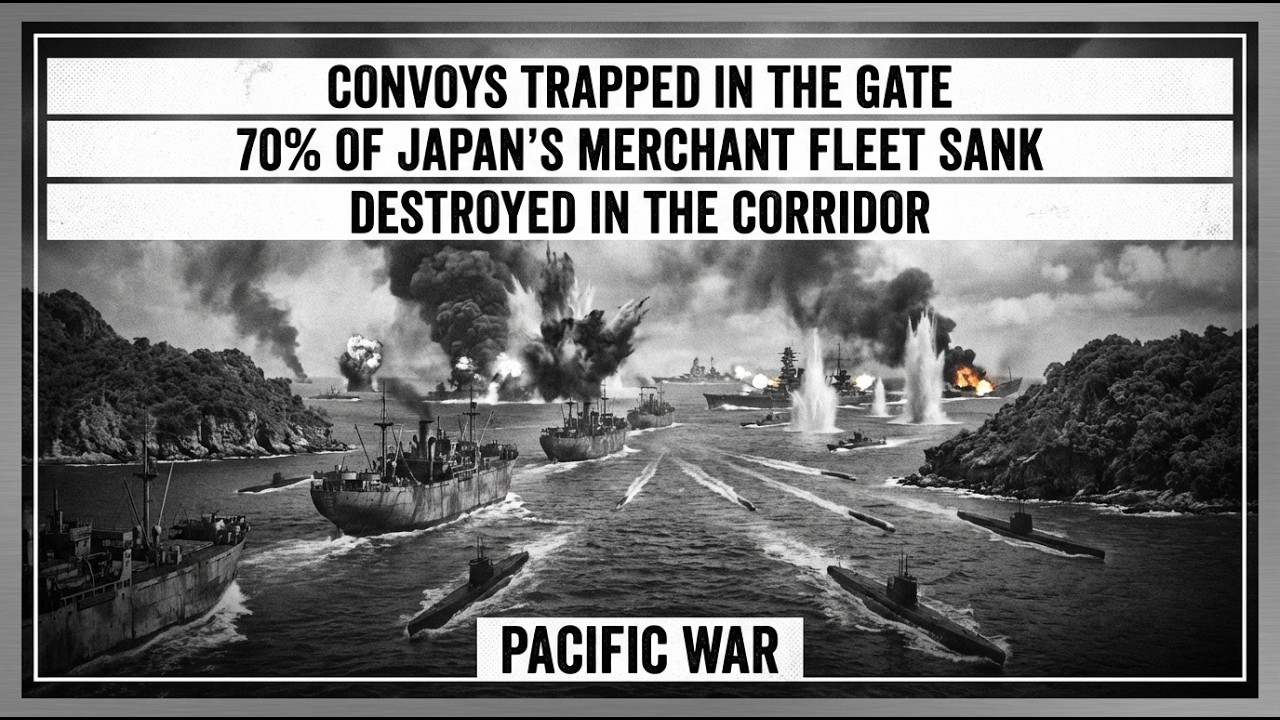
By late 1944, the most dangerous element in the western Pacific was not a fleet—it was a corridor. A chain of forced sea lanes stretched from Palawan through the Luzon Strait and past Formosa, channeling supplies straight to Japan. Every convoy sailed like a bead on a string, and American submarines discovered a chilling truth: geography itself could be weaponized. This video explores how these narrow routes, predictable by necessity, slowly starved frontline forces without a single massive battle.
The corridor’s strategic importance was immense. Japan’s war effort relied on fuel from the south, rubber, ore, and machinery—the lifeblood of frontline units. Convoys hugged coastlines and ports, creating choke points that American submarines exploited repeatedly. On September 12, 1944, a coordinated wolfpack—including USS Growler, USS Pampanito, and USS Sealion—demonstrated the deadly efficiency of this approach. The convoy could not escape; tight formations, predictable zigzag patterns, and restricted maneuvering made each movement a calculated risk. Over weeks, repeated patrols and attacks disrupted supply timing, delaying fuel, ammunition, and rations. Even when convoys survived, delays compounded, slowing the entire theater and demonstrating that a frontline collapses not only from lost bullets but from lost time.
Subsequent attacks reinforced the pattern. Geography forced choices upon escorts and convoy commanders, while submarines refined their tactics, learning currents, thermal layers, and patrol zones. Attempts to alter timing failed, and heavier convoys only amplified vulnerability. By mid-November, the corridor had become a systemic trap, eroding reliability of Japan’s supply chain and proving that control over movement can be as decisive as victory at sea. This documentary-style analysis reveals the silent but lethal power of naval strategy, showing how submarines leveraged geography to starve an entire front slowly but relentlessly.
Our channel is dedicated to uncovering untold WWII naval stories, revealing the strategies that shaped the course of the Pacific War. Subscribe for more in-depth explorations of undersea warfare, like if you learned something new, and comment which naval campaign you want us to cover next.
#SubmarineWarfare #PacificWar #WWIIHistory
⚠️ DISCLAIMER:
All visuals in this video have been generated using AI technology based on the historical narrative and descriptions provided in the script. These images are created for educational and illustrative purposes to enhance the storytelling of historical events. They are not actual photographs or footage from World War II. This content is intended solely for educational purposes to bring historical naval warfare strategies and operations to life for modern audiences.









Информация по комментариям в разработке