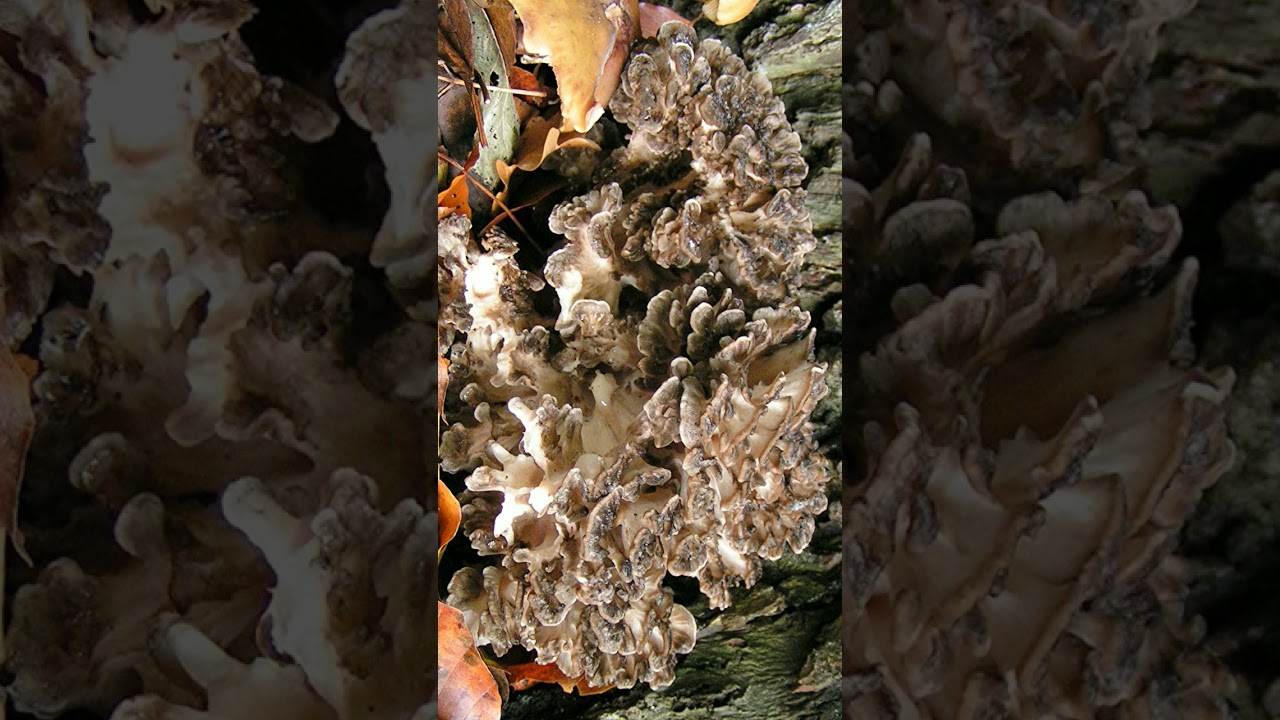
▪︎ Hen-of-the-Woods (Grifola frondosa) in Family (Grifolaceae) native to China, Europe & North America; it is a butt-rot fungus that often returns to same tree year after year.
Is a choice edible & medicinal polypore mushroom found primarily at base of oak trees in late summer & autumn.
It grows in large, overlapping clusters of Brownish-Grey, fan-shaped caps that resemble ruffled feathers of a hen.
Prized for its earthy, umami flavor & meaty texture, it is often simply sauteed in butter or oil.
◇ Health & Medicinal Potential
◆ Immune Support: Contains high levels of beta-glucans (specifically D-fraction & MD-fraction), which are studied for their ability to stimulate immune cells like macrophages and T cells.
◆ Metabolic Health: Research suggests it may help lower blood sugar & improve insulin sensitivity, making it a subject of interest for diabetes management.
◆ Nutritional Value: It is a rich source of antioxidants, vitamins B & C, potassium & fiber.
○ Usage & Foraging
● Culinary: Excellent in stir-fries, pastas & soups. It can be frozen directly without prior cooking.
● Supplements: Available in powder, tablet or extract forms.
● Safety: While generally safe, some individuals may experience gastrointestinal discomfort. Always ensure positive identification when foraging, as look-alikes like Black-Staining Polypore (Meripilus sumstinei) exist.
___
▪︎ Sulphur Shelf Mushroom (Laetiporus sulphureus) in Family Fomitopsidaceae name comes from Fomitopsis (meaning 'looking like Fomes') + -aceae. Its fruit bodies grow as striking Golden-Yellow shelf-like structures on tree trunks & branches. Old fruitbodies fade to pale beige or pale grey. Undersurface of fruit body is made up of tubelike pores rather than Gills.
♤ Class Agaricomycetes (40825), 1875,
☆ Order Polyporales (4064), 391.
Like (Laetiporus sulphureus) Sulphur Shelf, it is a perennial fungus that often grows in same place for several years in succession. It occurs most prolifically in the northeastern regions of United States, but has been found as far west as Idaho.
It grows from an underground tuber-like structure known as a sclerotium, about size of a potato. Fruiting body, occurring as large as 100 cm. rarely 150 cm, is a cluster consisting of multiple grayish-brown caps which are often curled or spoon-shaped with wavy margins & 2-10 cm broad. Undersurface of each cap bears about 1-3 pores per millimeter, with tubes rarely deeper than 3 mm. Milky-White stipe (stalk) has a branchy structure & becomes tough as the mushroom matures.
In Japan, it can grow to more than 45 kilograms. Species is a choice edible mushroom. It has been consumed for centuries in China & Japan where it is one of major culinary mushrooms. Mushroom is used in many Japanese dishes, such as nabemono. Softer caps must be thoroughly cooked.
___
⚽️ Domain Archaea - Archaea
⚽️ Domain Bacteria - Bacteria
⚽️ Domain Eukaryota - Eukaryotes ✔️
⚽️ Domain Not assigned
___
⚽️ Domain Eukaryota - Eukaryotes
♡¹ Kingdom Animalia - Animals
♡² Kingdom Chromista - Chromista
♡³ Kingdom Fungi - Fungi, Funguses ✔️
♡⁴ Kingdom Plantae - Plants
♡⁵ Kingdom Protozoa - Protozoan
___
♡³ Kingdom Fungi - Fungi, Funguses
♧¹ Phylum Ascomycota • 111506 - Ascomycete Fungi
♧² Phylum Basidiomycota • 56863 - Basidiomycete Fungi ✔️
...
___
♧² Phylum Basidiomycota • 56863 - Basidiomycete Fungi, Club Fungi
♤¹ Class Agaricomycetes • 43754 - Mushrooms, Bracket Fungi, Puffballs ✔️
♤ Class Agaricostilbomycetes • 111
♤ Class Atractiellomycetes • 72
♤ Class Classiculomycetes • 3
♤ Class Cryptomycocolacomycetes • 2
♤ Class Cystobasidiomycetes • 102
♤ Class Dacrymycetes • 228
♤ Class Exobasidiomycetes • 895
♤ Class Malasseziomycetes • 23
♤ Class Microbotryomycetes • 385
♤ Class Mixiomycetes • 1
♤ Class Moniliellomycetes • 19
♤ Class Peribolosporomycetes • 1
♤ Class Pucciniomycetes • 8759
♤ Class Spiculogloeomycetes • 19
♤ Class Tremellomycetes • 913
♤ Class Tritirachiomycetes • 18
♤ Class Ustilaginomycetes • 1505 - Smut Fungi
♤ Class Wallemiomycetes • 28
___
♤¹ Class Agaricomycetes • 43754 - Mushrooms, Bracket Fungi, Puffballs
☆¹ Order Agaricales • 27157
☆² Order Amylocorticiales • 73
☆³ Order Atheliales • 129
☆⁴ Order Auriculariales • 448
☆⁵ Order Boletales • 2640
☆⁶ Order Cantharellales • 1105
☆⁷ Order Corticiales • 264
☆⁸ Order Geastrales • 182
☆⁹ Order Gloeophyllales • 60
☆¹⁰ Order Gomphales • 572
☆¹¹ Order Hymenochaetales • 1600
☆¹² Order Hysterangiales • 152
☆¹³ Order Jaapiales • 3
☆¹⁴ Order Lepidostromatales • 15
☆¹⁵ Order Phallales • 232
☆¹⁶ Order Polyporales • 4401
☆¹⁷ Order Russulales • 3732
☆¹⁸ Order Sebacinales • 128
☆¹⁹ Order Sistotremastrales • 14
☆²⁰ Order Stereopsidales • 19
☆²¹ Order Thelephorales • 568
☆²² Order Trechisporales • 187
☆²³ Order Tremellodendropsidales • 10
___
☆¹⁶ Order Polyporales • 4401, 443, F³⁷
•¹⁴ Family Grifolaceae • 14, 2
▪︎ Genus Grifola • 12
___










Информация по комментариям в разработке