Red Tiger Discus Aquarium Stunning Fish Tank With Real Water Sounds🐟🐠Relax🦈🐬❤️👍
Red Tiger Discus
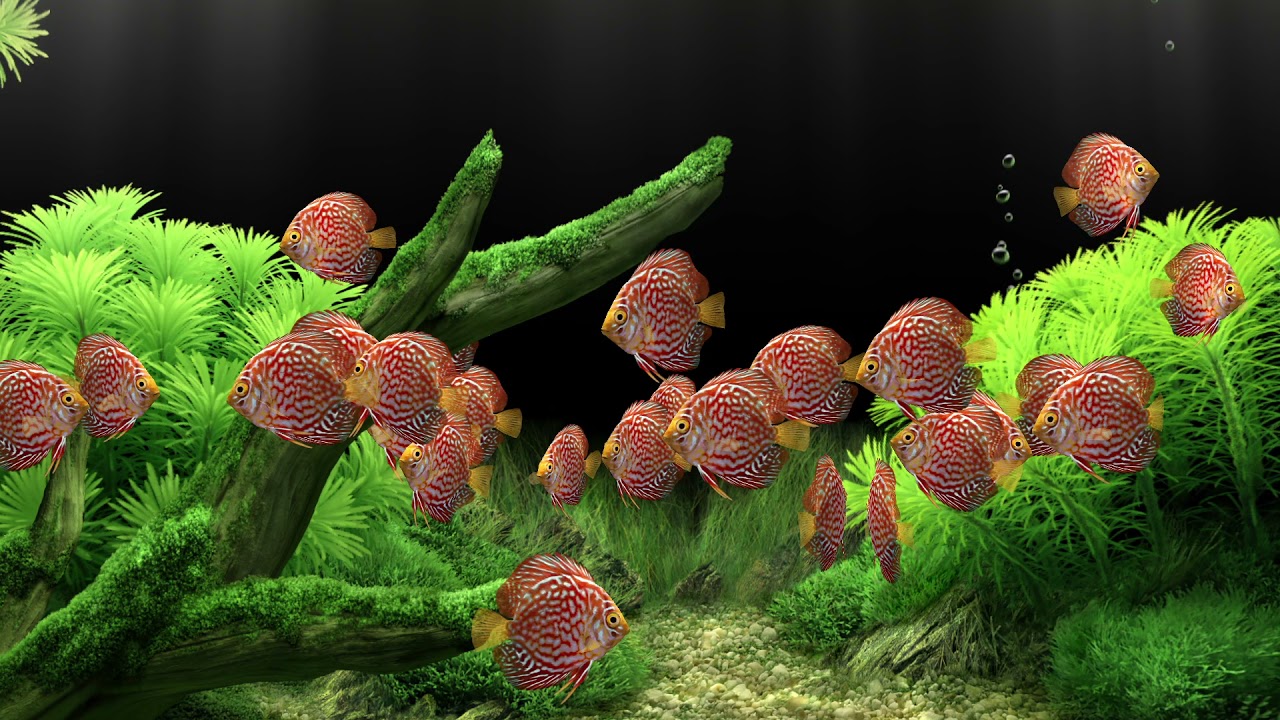
The red tiger discus is a standout even among the wide variety of vividly colored and patterned cultivated discus. It is a beautiful blend of spots, striations, and stress bars that creates a discus that will be the star of your tropical aquarium. The red tiger discus has a tan to gold colored body that is covered with an engaging pattern of red spots and striations. It has the stress bars of a classic, wild discus, but the color of the bars on the body is faint. The exception is the head of the red tiger discus, which has a very dark stress bar running through its eyes. The pectoral and dorsal fins of the red tiger discus have red striations and thin stripes on them. The tail fin of this discus is a pale gold or tan color.
The red tiger discus has a round, flat body. At maturity, it can reach a length of 8.” The red tiger discus is round due to the fact that it is almost as tall as it is wide. In addition, the full dorsal and pectoral fins also contribute to its delightfully round shape. As one of the most striking discus ever bred, the red tiger discus is a beautiful show fish that adds a burst of color to your tropical aquarium. Whether you interested in a collection of multi-colored discus or focusing on just a school of red tiger discus, this uniquely beautiful tropical fish is an excellent showpiece for your freshwater aquarium.
These fish are disc-shaped and can reach up to 10 inches. They aren’t easy to keep so only experienced aquarists should own them. Discus fish are extremely popular in the hobby, as such, they have been highly hybridized. Nowadays there are plenty of color, pattern and shape varieties.
To keep these fish in captivity, water pH should be between 6.0 and 6.5 and water temperature should range from 82ºF to 86ºF. The tank should be dimly lit and have open areas for swimming, plants, hiding places, and a sandy or gravel substrate. They are peaceful and can be kept in a community tank. Discus can be kept as a single fish and for such a 50-gallon tank is the minimum required, to keep more than one, a larger tank is necessary.
The water in which these fish are packaged is different from the water in the tank since these fish are extremely sensitive to water conditions the acclimation process is very important. This process should never be rushed. Aquarium lights should be off for at least the first 4 hours of the fish in the new tank and it should not be fed in the first 24h. There are two acclimation methods: Floating Method and the Drip Method.
Floating method - the aquarium lights should be off and lights in the room should be dim, the bag in which the fish is should be placed on the surface of the water to float for about 15 minutes, this allows the water in the bag to adjust to the water in the tank. The bag should then be cut under the knot and the top edge of the bag should be rolled down one inch, then ¼ cup of the aquarium water should be added to the bag, this step should be repeated every 4 minutes until the bag is full, then half the water of the bag should be discarded and the bag should be put to float again and ¼ cup of the aquarium water should be added to the bag every 4 minutes until the bag is full. Afterward, the Discus can be moved into the aquarium.
Drip method – the aquarium lights should be off and lights in the room should be dim, the bag in which the fish is should be placed on the surface of the water to float for about 15 minutes, this allows the water in the bag to adjust to the water in the tank. The bag contents should be poured into a 1-gallon bucket that has never been cleaned with any chemicals, the fish should be enterally submerged. A siphon, using airline tubing, should be set up and a drip line should run from the main aquarium to the bucket. Several loose knots should be tied in the airline tubing to regulate flow. Sucking the end of the airline tube that goes to the bucket will begin a siphon, the flow should be regulated to 2 to 4 drips per second. Once the water in the buckets doubles, half should be discarded and the process should be repeated until it doubles again. Afterward, the fish can be moved to the aquarium.

Информация по комментариям в разработке