On April 20, 2020, in an unprecedented, sweeping move, the Massachusetts Legislature passed, and Governor Charlie Baker signed into law, An Act Providing For a Moratorium On Evictions and Foreclosures During the COVID-19 Emergency (House Bill 4647), a statewide moratorium on the vast majority all evictions and foreclosures in Massachusetts during the COVID-19 Emergency — and possibly well beyond. The new law is in effect until 45 days after the Coronavirus (COVID-19) Emergency is lifted by Gov. Baker, or four (4) months, whichever is earliest, however, Gov. Baker is permitted to extend the law for 90 day increments.
The Eviction Moratorium covers 90% of all evictions (summary process), including non-payment and no-fault evictions, both residential and commercial. The only exception is if a tenant is engaged in criminal activity or a lease violation which impacts the health and safety of other residents or first responders. Under the Act, Housing and District Courts will not even accept new eviction filings. Eviction cases which are already pending in court are effectively suspended until the law expires. (Under previous Housing Court orders, all evictions have been stayed until May 4). Eviction move-out orders are also suspended. All court deadlines and statutes of limitations are suspended.
Further, Landlords are prohibited from issuing notices to quit or terminating a lease. Late fees for unpaid rent are also banned. Landlords are also barred from reporting delinquencies to credit reporting agencies if the tenant provides documentation of financial hardship related to the COVID-19 crisis.
The Moratorium also applies to certain “small business” commercial spaces. Small businesses are defined as any in-state for-profit and non-profit business with less than 150 full-time equivalent employees. It does not apply to chains or businesses operating multi-state, multi-nationally, or publicly traded companies. Commercial landlords may, however, issue payment default notices and notices to quit.
Under the Act, all residential property foreclosure proceedings are prohibited and suspended. The Act appears not to give foreclosure relief to investment or rental property owners, and that is one of the glaring inequities as discussed below. Lenders are banned from sending foreclosure notices, filing Land Court Servicemembers proceedings, conducting foreclosure auctions, or otherwise engaging in any foreclosure related action under state law. The Act also requires banks to grant up to 180 days of mortgage forbearance to homeowners who have been hurt by the coronavirus crisis. However, the forebearance will be added to the end of the term of the loan. The foreclosure relief part of the law expires 45 days after the Covid Emergency is lifted, or 4 months, whichever is sooner, but the Governor may issue 90 day extensions. The Act does not suspend the obligation to pay one’s mortgage.
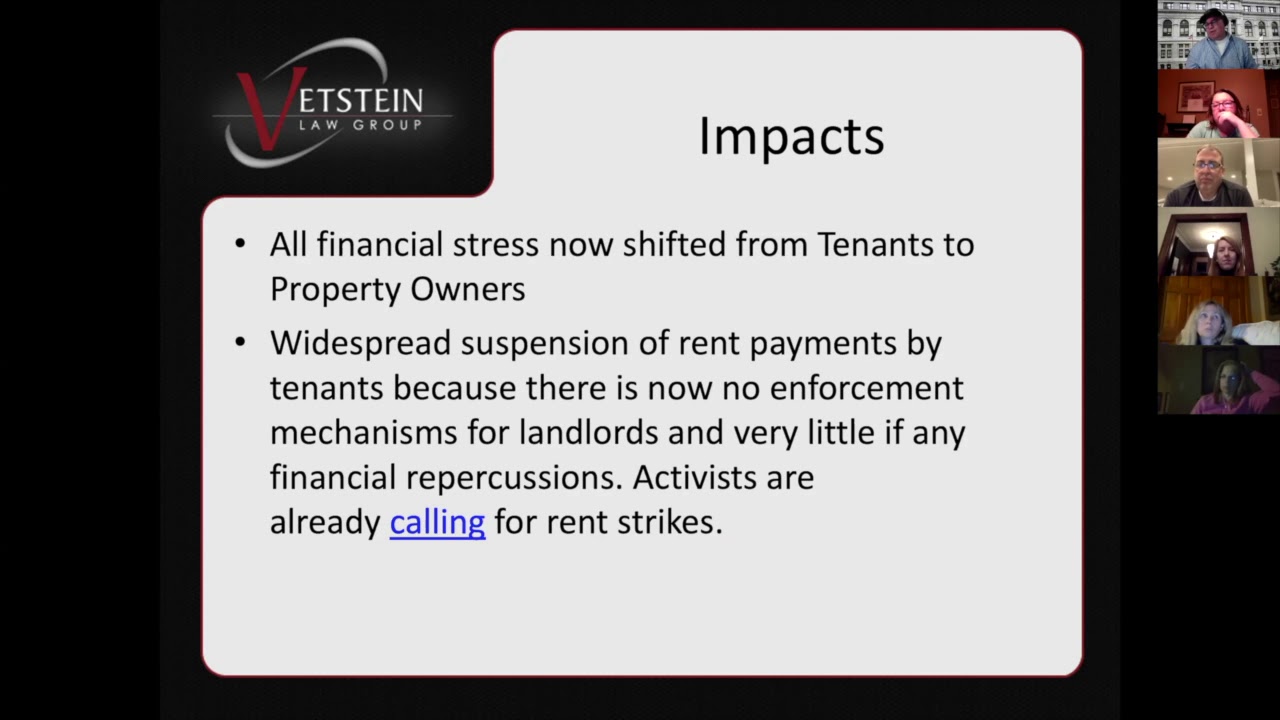
This Act will likely result in widespread suspension of rent payments by tenants because there is now no enforcement mechanisms for landlords and very little if any financial repercussions. Activists are already calling for rent strikes.
Aside from the financial considerations, there are also a number of constitutional and legal flaws with the law under the Massachusetts State Constitution, including violating the right to access courts, the Equal Protection Clause, usurping the exclusive role of the judiciary, violating the Takings Clause, and other major problems. We have not seen this type of sweeping restriction on property owner rights since the days of rent control. I think this Act has a high chance of being struck down by the Supreme Judicial Court.
With the backing of MassLandlords, our statewide trade association, a group of talented attorneys including myself are exploring a legal challenge to the Act. If you are interested in donating or participating in the case, please contact me at [email protected]. We have set up a secure Paypal funding link for any donations here: https://paypal.me/pools/c/8orbLzpxbY.

Информация по комментариям в разработке