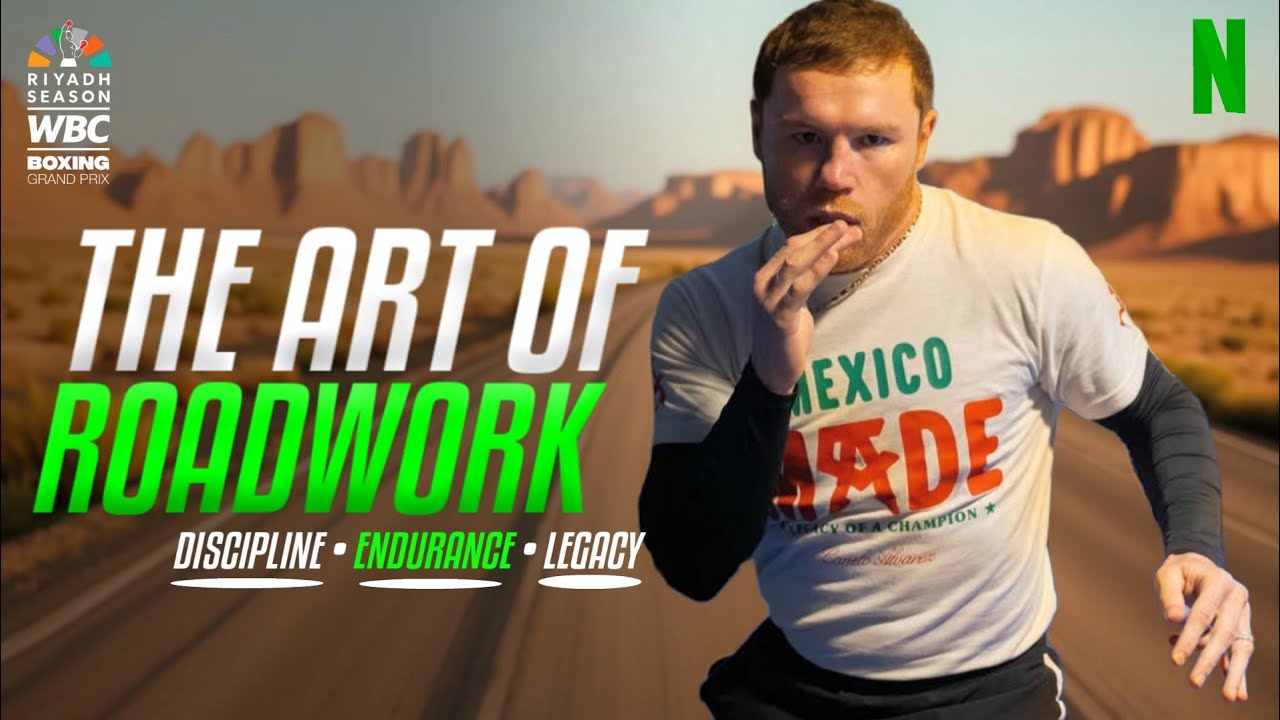
The art of roadwork has been the heartbeat of boxing for over a century, and in today’s era, few fighters embrace it the way Canelo Álvarez does. While the modern sport is filled with advanced equipment, high-performance gyms, and cutting-edge science, roadwork remains untouched, pure, and necessary. For Canelo, it is more than conditioning — it is a way of life, a discipline that has carried him from a young prospect in Mexico to one of the greatest fighters of his generation.
When you see him running, it’s never just about covering miles. It’s about rhythm, balance, and control. On the road, Canelo is free — carving out long stretches, steady in his breathing, building endurance that cannot be faked in the gym. The pounding of the pavement under his feet is like a metronome, keeping pace with the mental rhythm that every great fighter needs. Out there, every stride is a rehearsal for the later rounds, where fights are won not by skill alone, but by who can keep going when fatigue sets in.
But there’s another side to Canelo’s roadwork — the race track. This is where endurance meets structure. On the open roads, the challenge is unpredictability: hills, turns, surfaces that force adaptation. On the track, the challenge is precision. Lap after lap, the circle demands focus. Canelo blends long stretches of steady laps with sudden bursts of sprints, a perfect reflection of what happens in the ring. Boxing is not fought at one pace; it’s a constant shift between patience and explosion, and roadwork on the track is the closest mirror to that reality.
The track also allows measurement. Canelo can time his sprints, count his laps, and structure his breathing to match the demands of a fight. He builds that crucial ability to recover quickly between bursts — the same way he recovers between flurries of punches, between rounds, between moments of all-out intensity. It’s here that his conditioning sharpens, transforming from raw endurance into fight-specific stamina.
What makes Canelo’s approach so powerful is the combination of both worlds. The roads give him grit — the kind of toughness that comes from running through unpredictable terrain, adapting with every step, and embracing the grind of long, lonely miles. The track gives him sharpness — the ability to pace himself, to burst on command, and to master the tempo of his body. Together, they create a fighter who doesn’t fade, a fighter who thrives as the rounds grow deeper.
Roadwork is often overlooked, because it doesn’t shine under the bright lights. There are no cameras, no cheering fans, no glamour. But it is in those runs — on dusty roads or smooth tracks — that champions are made. For Canelo Álvarez, it’s not just about conditioning; it’s about identity. The discipline of roadwork is woven into who he is as a fighter. Every time he steps into the ring, his legs steady under pressure, his engine unshakable, and his will unbroken, it’s a reflection of all those unseen miles.
That is why the art of roadwork still matters. It’s not old-fashioned. It’s timeless. It’s the grind that builds champions like Canelo — the silent, relentless practice that ensures when the fight reaches its most brutal moments, he is the one still standing strong.
At GH Boxing Workout, we are dedicated to providing insightful analysis, keeping you informed, and fueling your passion for boxing. Join us on our social platforms and become part of our growing community of fight fans.
Copyright Disclaimer under Section 107 of the copyright act 1976, allowance is made for fair use for purposes such as criticism, comment, news reporting, scholarship, and research. Fair use is a use permitted by copyright statute that might otherwise be infringing. Non-profit, educational or personal use tips the balance in favour of fair use

Информация по комментариям в разработке