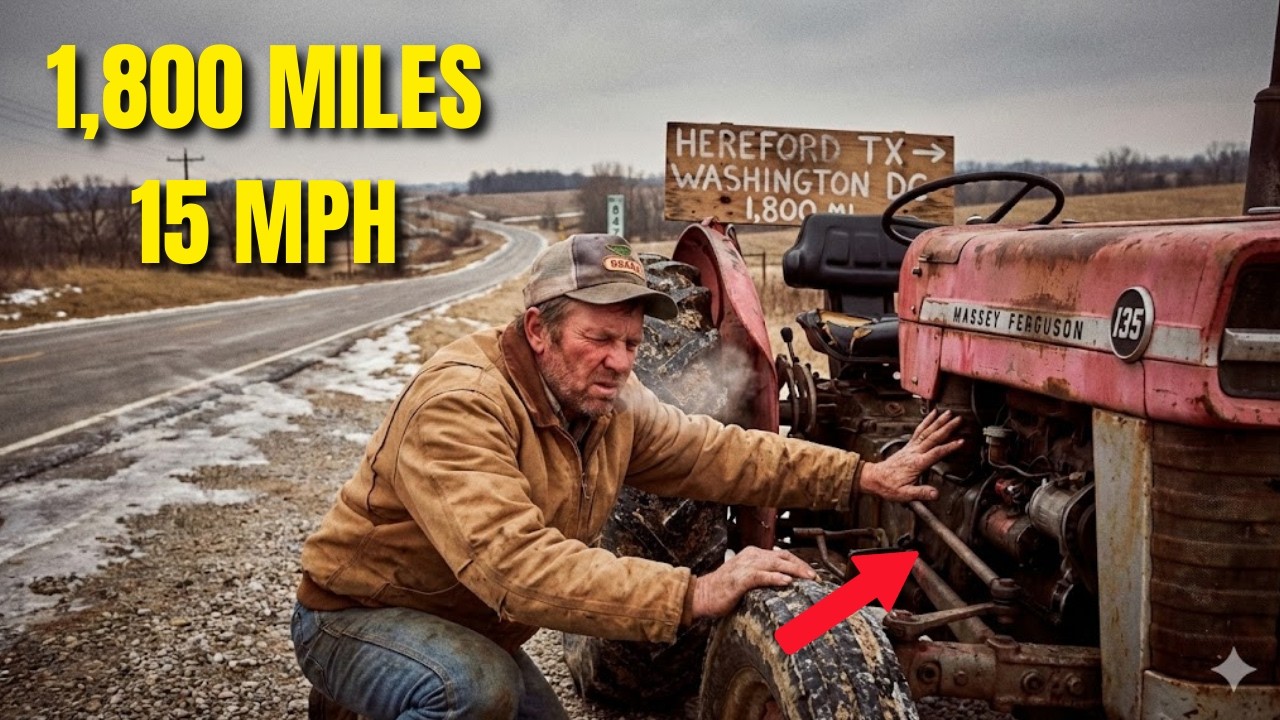
In 1979, a bankrupt Texas farmer named Gerald McCathern made a desperate decision that would change American agricultural policy forever. He drove his tractor 1,800 miles from Hereford, Texas to Washington DC—not on a trailer, but on the highway at 20 miles per hour through winter weather. What started as one man's protest became the largest farmer demonstration in American history.
This is the true story of the 1979 Tractorcade, when 5,000 farmers drove their tractors across America and occupied the National Mall for weeks, demanding changes to farm policy that was bankrupting rural communities across the Great Plains.
The Farm Crisis of the Late 1970s
The American Agriculture Movement formed in response to the devastating 1977 Farm Bill. Commodity prices had collapsed—wheat that cost $18 per bushel to produce was selling for $11. Meanwhile, interest rates on farm equipment loans skyrocketed from 8% to 22%. Farmers who followed Secretary of Agriculture Earl Butz's advice to expand and "plant fence row to fence row" now faced foreclosure.
Gerald McCathern, a 53-year-old wheat farmer from Deaf Smith County, proposed an audacious plan: drive tractors directly to the politicians' doorstep in Washington DC.
The Journey: January-February 1979
On January 24, 1979, McCathern climbed into his brand-new International Harvester 1486 tractor and headed east on Interstate 40. The convoy started with just 15 tractors at Amarillo but grew to over 100 by Arkansas. Four separate routes converged on Washington—I-20 from Lubbock, I-40 from Amarillo, I-70 from Denver, and I-80 from Cheyenne.
The public response stunned everyone. Small-town Americans lined highways to cheer, café owners refused payment, mechanics donated repairs. By the time the convoy reached Tennessee, it was national news.
February 5, 1979: Washington Occupation
When 5,000 tractors rolled down Constitution Avenue and occupied the National Mall, Washington DC came to a complete halt. Metropolitan Police, expecting a few hundred protesters, watched in disbelief as this diesel-powered army parked from the Capitol to the Washington Monument.
The occupation lasted weeks. Farmers lobbied congressmen, testified before committees, and handed out pamphlets explaining cost-of-production economics. Washington initially dismissed them as troublemakers—until a President's Day blizzard paralyzed the city and farmers used their tractors to pull cars from snowbanks and clear roads. Overnight, the narrative shifted.
The Legacy
Did Tractorcade immediately change farm policy? Marginally. But it transformed how rural America organized itself. Before 1979, farmers wrote letters that got filed away. After Tractorcade, Washington listened. The loan programs, price supports, and crop insurance protections that exist today trace their roots to that February occupation.
Gerald McCathern's International Harvester 1486 now sits in the Smithsonian National Museum of American History—a permanent reminder that democracy sometimes requires showing up, literally and physically.
The Forgotten History
The agricultural crisis of the 1980s still came—half of America's family farms disappeared, rural communities collapsed. But Tractorcade proved farmers could organize, mobilize, and make the nation pay attention. It showed that a five-foot-six wheat farmer from Texas could coordinate 5,000 people, four convoy routes, and force Congress to acknowledge that American agriculture was dying.
This documentary tells the complete story using authentic historical details, period photographs, and the exact timeline of events from December 1978 through March 1979.

Информация по комментариям в разработке