Stroke Risk Estimation Using Viscoplastic Energy Method (VMT) of Physics and Topological Data Analysis (TDA) of Mathematics (No. 1377, VMT #717, TDA #001, 10/4/2025)
Gerald C. Hsu
EclaireMD Foundation
Category: Neuroscience & Computational Medicine
This study pioneers the use of Topological Data Analysis (TDA) beyond medical imaging, applying it to a 16-year longitudinal pathophysiological dataset (2010-2025) for stroke risk estimation. By integrating TDA with the physics-based Viscoplastic Medicine Theory (VMT), it introduces a unified framework linking geometry and energy in human health. This approach offers a new pathway for personalized medicine that is more responsive to lifestyle changes than traditional, age-dominant models like the Framingham Stroke Risk Profile (FSRP).
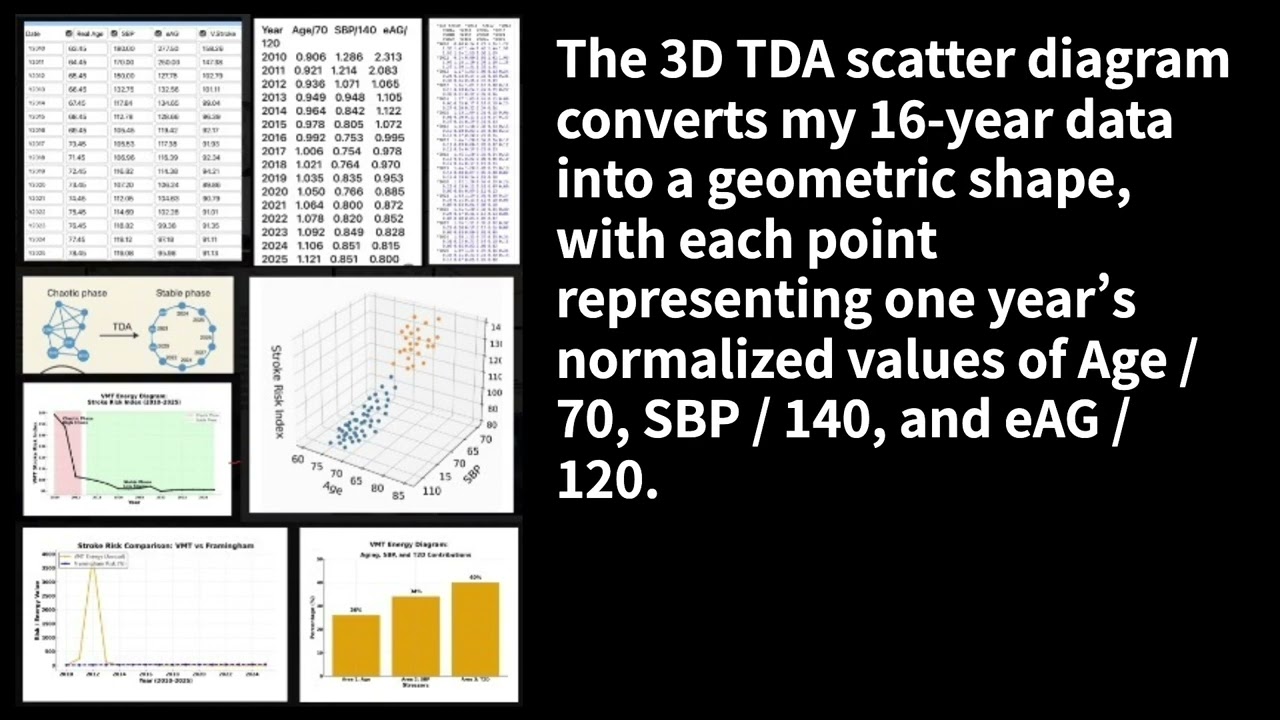
The method utilized three key input variables: real age, systolic blood pressure (SBP), and estimated average glucose (eAG), with the output being a VMT-based stroke risk index representing vascular strain. All inputs were normalized (Age/70, SBP/140, eAG/120). For the TDA analysis, the Euclidean distance between annual data points in a three-dimensional space was calculated, followed by a Vietoris-Rips complex to identify connected components. The VMT analysis used established calculations quantifying stress-strain interaction and cumulative vascular damage.
TDA results revealed a single major connected cluster, indicating one overall health phase with a single structural transition across the 16-year period. From 2010 to 2012, the average pairwise distance among data points was high at 0.34, reflecting physiological instability. This distance steadily decreased after 2013, reaching 0.09 by 2025, signifying that the system became more stable and homogeneous. During the 2010-2012 period of high blood pressure and glucose, the data manifold showed high local curvature. It tightened rapidly from 2013 to 2015 and became compact and spherical from 2015 onward, changing from an unstable to a smooth geometry.
The VMT dynamic energy model and TDA structural shape analysis describe the same health journey from the complementary perspectives of physics and mathematics. The VMT model showed stroke energy dropping from 3945 units in 2012 to below 100 after 2015, a 97% reduction in cerebrovascular stress energy. Concurrently, the TDA model showed the geometry of the health data contracting by 73%. Both models identified 2010-2012 as the period of instability and 2015 as the turning point toward equilibrium. This consistency confirms the mutual validity of both approaches. A comparison with the Framingham-lite index showed a high correlation of 0.995.
A VMT energy contribution analysis identified the primary forces behind the stroke-related stress load: type 2 diabetes (T2D) at 40%, SBP at 34%, and biological age at 26%. This suggests diabetes acted as the chronic underlying factor weakening blood vessels, while blood pressure served as the acute trigger capable of causing vascular rupture. This pattern aligns precisely with the author’s hemorrhagic stroke on June 21, 2025, which occurred during an acute hypertensive episode after decades of cumulative metabolic damage from diabetes.
The health journey from 2010 to 2025 can be characterized in three phases. From 2010 to 2012, high SBP and eAG produced a chaotic pattern, with a widely scattered TDA manifold and high VMT energy values (index 158 → 102), indicating instability. Between 2013 and 2015, the manifold contracted as variables became more coherent, corresponding to a sharp VMT energy drop. After 2015, the geometry became nearly spherical and the VMT energy stabilized below an index of 100, signifying low internal stress and high systemic resilience.
In conclusion, this 16-year study demonstrates that VMT and TDA together describe the same biomedical reality, with VMT measuring dynamic energy dissipation and TDA visualizing structural order. Both methods revealed that 2010–2012 were years of metabolic disorder, 2013–2015 was a recovery phase, and 2016–2025 represented a stable equilibrium. Unlike static, age-based models, this dual approach responds to real-time physiological changes, showing that stroke risk can be significantly reduced through disciplined lifestyle management. The human body behaves both as a dynamic energy system and a geometric structure, capable of transforming from chaos to stability through measurable self-reorganization.
#healthtalk #eclairemd #neuroscience

Информация по комментариям в разработке