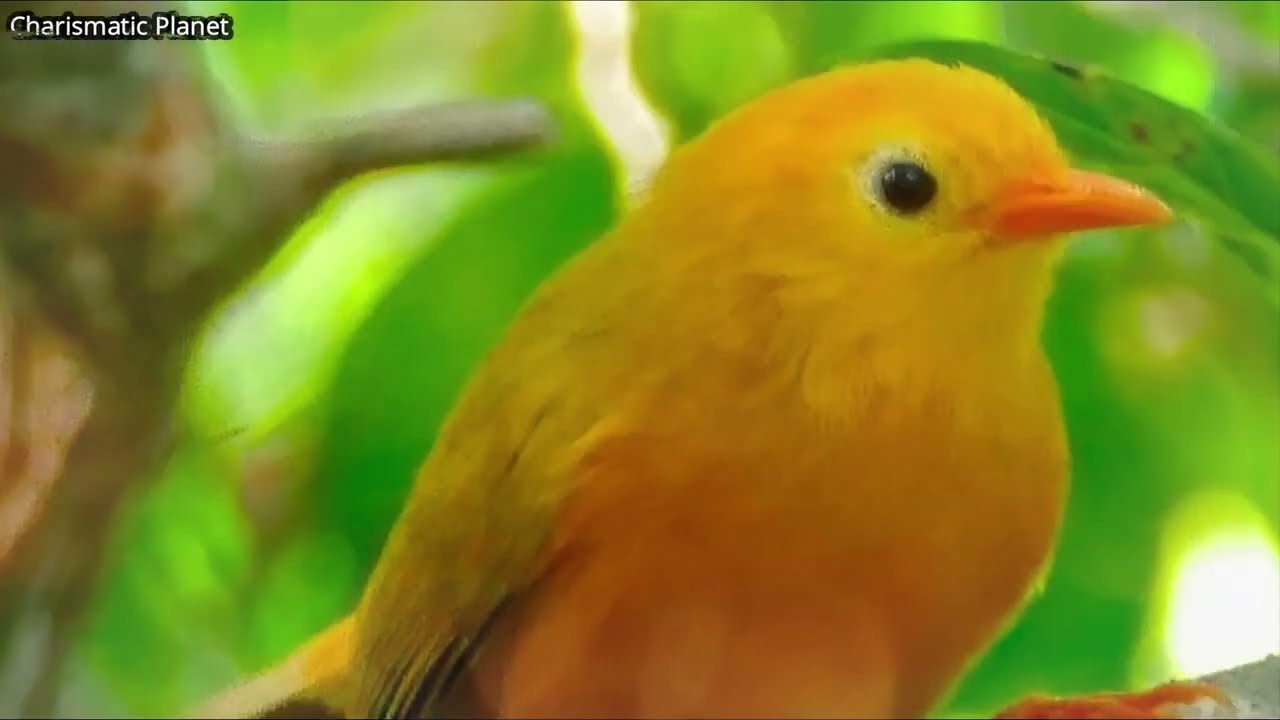
A beautiful unique, entirely yellowish white-eye. Bright golden yellow on the head with a paler eye-ring, yellowish-green wings, and a darker orange-yellow coloring below. Bill and legs pale yellow-orange. Song is a rambling warble that sounds like “can you see me? I can see you.” Call is a raspy “tchup.”
Golden White-eyes occur in all wooded habitats on Saipan, including native limestone forest, thickets, strand forest, and suburban areas; however, they are generally absent from sword grass savannah. Nesting densities in native limestone forest and thickets suggests that the species nests predominately in the native forest. Golden White-eyes does well in virtually all woody vegetation types, especially brushy areas that are abundant in plants with small leaves or leaflets.
#birds #birdslovers #birding #birdwatching #birdsounds #birdsvideos #birdswatching
Hit & Subscribe - https://bit.ly/369FbLd
How to build an Aviary - https://bit.ly/3emBLJZ
Stop Your Parrot From Biting, Train Tricks, Speech - https://bit.ly/3xNqyJX
Visit Website: https://charismaticplanet.com
Follow us on Instagram: / charismaticplanet
Follow on Pinterest: / dreamzsnet5
Follow on Twitter: / charismaticpla1
2nd Website - https://cricketthrills.com/
Catalan: zostèrops daurat
Czech: kruhoočko zlaté, Medosavka zlatá
Danish: Gylden Brillefugl
German: Goldbrillenvogel, Goldhonigfresser, Gold-Honigfresser
English: Golden Honeyeater, Golden White eye, Golden White-eye
English, HBW: Golden White-eye
English (IOC): Golden White-eye
English (United States): Golden White-eye
Esperanto: Aŭra kleptorno
Spanish: Anteojitos Dorado, Pájaro Miel Dorado
Spanish (Spain): Anteojitos Dorado
Spanish (HBW): Golden White-eye
Finnish: kultarilli, saipaninmesikko, Saipansaarenmesikko
French: Zostérops doré
Croatian: zlatna bjelooka
Hungarian: aranyos pápaszemesmadár
Italian: Mangiamiele dorato, Occhialino dorato
Japanese (romaji): ougommitsusui, ougonmitsusui
Japanese: オウゴンミツスイ
Scientific: Cleptornis marchei, Ptilotis Marchei
Lithuanian: Auksinis baltavokis
Dutch: Gouden Brilvogel
Norwegian Nynorsk: Gyllenbrillefugl
Norwegian: Gyllenbrillefugl
Polish: zlotoszlarka, złotoszlarka, złotoszlarnik
Portuguese: Olho-branco-dourado
Portuguese (Portugal): olho-branco-dourado
Russian: Золотистая тахоу, Золотой медосос
Slovak: okánik pôvabný
Serbian: Zlatna belooka
Swedish: gyllenglasögonfågel, Gyllenhonungsfågel
Turkish: Altın rengi gözlükçü
Ukrainian: Окулярник золотий
Chinese: 金绣眼鸟
Chinese (Traditional): 金色繡眼
Copyright Disclaimer Under Section 107 of the Copyright Act 1976, allowance is made for "fair use" for purposes such as criticism, commenting, news reporting, teaching,Music, scholarship, and research. Fair use is a use permitted by copyright statutes that might otherwise be infringing. Non-profit, educational, or personal use tips the balance in favor of fair use.
Reference:
https://support.google.com/youtube/th
...
https://www.multiplechronicconditions
...
https://bit.ly/3l8GUbc
Section 107 of the Copyright Act 1976:
https://www.copyright.gov/fair-use/mo
...
https://www.copyright.gov/title17/92c
...
1)This video has no negative impact on the original works (It would actually be positive for them).
2)This video is also for teaching purposes.
3)It is not transformative in nature.
Thanks for visiting our channel your support is really helping us to grow a good channel. Please hit the like and subscribe button 👆 in the corner of the video for more of our videos don't forget to turn on the notification bell🔔

Информация по комментариям в разработке