Let’s have a talk with sugars! Because, as glycobiologists show us, these molecules have a lot to say - about much more than just “here’s some energy”! Sugars (aka carbohydrates or “carbs”) play lots of roles but you usually only hear about a couple: energy storage is an important role some sugars play (like glycogen in animals and starch in plants), & sugars like cellulose are touted for their structural support roles. In those roles, sugars “act alone” but sugars can also be used to “dress up” other molecules. Basically, cells can cover their surface with (as well as secrete) carefully-made “forests” of “sugar trees” anchored to proteins, lipids, etc. to allow for cellular communication, immune system surveillance, etc. It’s really sweet stuff!
blog form: https://bit.ly/sugarssci
Nucleic acids (DNA & RNA) with their nucleotide “alphabet” and proteins with their amino acid “alphabet” tend to get most of the attention. But did you know there’s also a sort of sugar alphabet? Its letters are monosaccharides like glucose & galactose and they can get attached (conjugated) in a bunch of different ways to a bunch of different things (proteins, lipids, other sugars). These different combos have different names (proteoglycans, glycoproteins, glycolipids, etc.) and today I want to help you make sense of what these sometimes sense-ational molecules are & what they do.
Let’s start with “What the heck is a sugar anyway?” In one of the cases where the jargon-y terms can actually make things less confusing, the technical term for a sugar is a carbohydrate. As the name implies, these are “hydrated carbons” - but it’s not like you can just pour some Gatorade on a diamond and, voila! Instead, there are certain defining characteristics…
The basic formula for an (unmodified) carb is Cx(H₂O)x. so you have an average of 1 water molecule per carbon atom (and you need to have a chain of at least 3 carbons). In order to cram that many (equivalents of) water molecules in, carbs take the form of olyhydroxy aldehydes or polyhydroxy ketones. This mumbojumbo just means that there are lots of (poly) (-OH) (aka hydroxyl) groups as well as a carbonyl (C=O) group. If that (C=O) is at the end of the carbon chain, we call it an aldehyde and if its somewhere in the middle we call it a ketone.
If you’re on the lookout for sugars, your clues are lots of -OH groups (and names that in “-ose”).
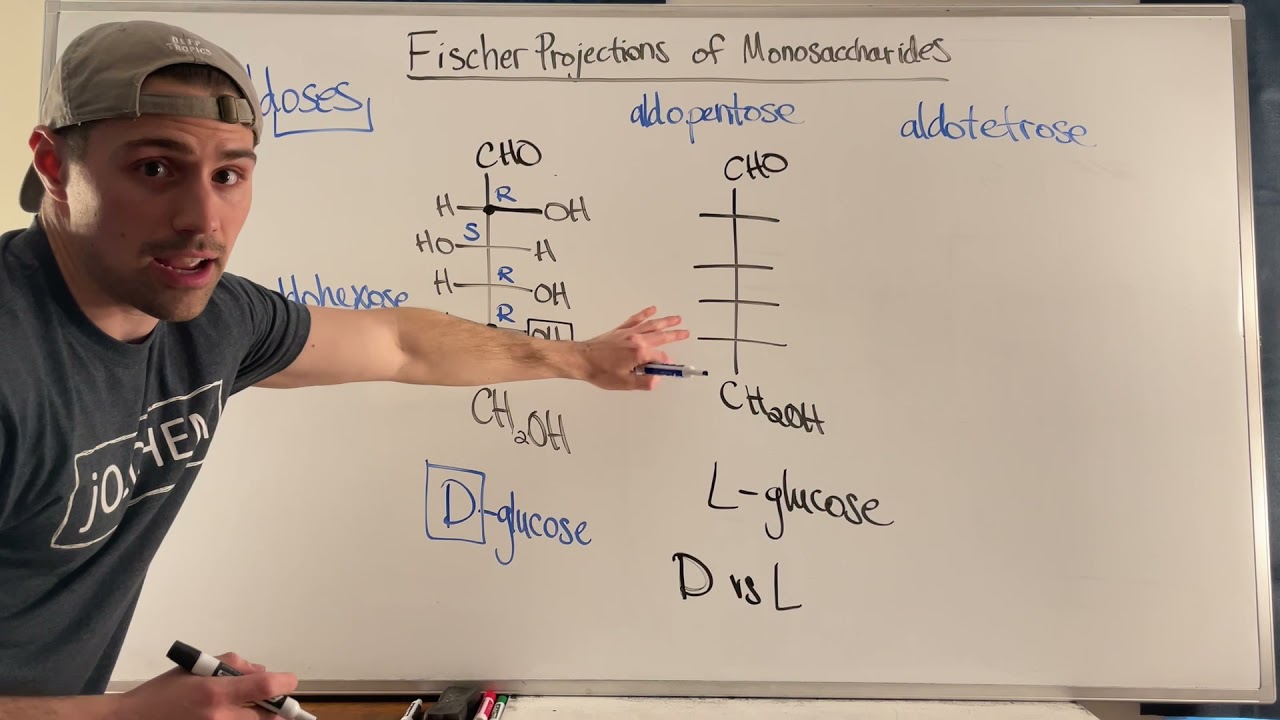
The simplest sugars are called monosaccharides. They have 3-9 carbons, but usually 5-7 (we call the 5-C ones pentoses & the 6-C ones hexoses). Since they can have aldehyde or ketone groups, they can be further classified as aldoses & ketoses. So, for example, glucose is an aldohexose (6-carbon aldehyde sugar), fructose is a ketohexose (6-carbon ketone sugar), and ribose is an aldopentose (5-carbon aldehyde sugar). note: A lot of times you can’t actually “see” the carbonyl (C=O) because monosaccharides use it to “ring-ify” (I think this is easiest to explain visually, so check out the pics). During the ringification, this carbonyl turns into a hydroxyl (-OH) & depending on how they ring-ify, it can be sticking up or down from the ring (positions termed α (if it sticks down) & β if it sticks up).
note: The rings can be drawn a few different ways because the atoms in the rings can move a bit to try to get more comfy. They stay connected so the whole structure has to adjust - you can think of it kinda like if you were to squish one of those water bottle cap rings in different ways. A lot of the common monosaccharides hang out in a squashed version called the “chair conformation” which is how I’m drawing them in most of the pics.
Based just on what I’ve told you so far, monosaccharides might seem pretty boring - especially if you compare them to amino acids (protein letters). As a refresher, there are 20 (common) amino acids and they have a wide variety of “side chains” (aka R groups) with different sizes, charges, etc. Compared to those, monosaccharides might seem like pretty lame letters. I mean, they just have a lot of -OHs. But a lot of protein side chains are actually pretty “boring” - in fact, a few of the most exciting are serine, threonine, & tyrosine - which are exciting because they have -OHs. an -OH can take you many a place! And instead of just having one, these sugars have many. -OH the many places you can go!
continued in comments








Информация по комментариям в разработке