▪︎ Goji Berry, Barbary Wolfberry (Lycium barbarum) in Nightshade Family (Solanaceae) native to East Asia, particularly China.
Lycium from lykion term was used by ancient figures like Pliny the Elder and Pedanius Dioscorides to describe a thorny plant likely a species of buckthorn (Rhamnus) found in ancient region of Lycia (Southern Anatolia). • Linguistic Confusion: Lycium mistakenly linked to lycos 'wolf' leading to common name 'wolfberry' true botanical root is place name Lycia. Specific Epithet barbarum 'foreign' compared to native European species (Lycium europaeum).
Matrimony-Vine, Common Matrimony Vine, Tibetan Goji, Himalayan Goji, Duke of Argyll's Teatree, Barbary Matrimony-Vine
A suckering, densely branched shrub typically reaching heights of 0.5-3 metres. Its long, weak stems often arch or sprawl to form thickets. Branches are light Gray or Gray-Green, often thorny & exhibit secondary growth as they age.
Leaves: Simple, Green & arranged either alternately or in small bundles (fascicles) of up to 3. Lanceolate (spear-shaped), elliptical, or oblanceolate. Generally 2-6 cm long & 3-6 mm wide, narrowing toward a short petiole.
Flowers are distinctive, trumpet-shaped blooms that transition from vibrant Purple to pale Beige as they age. They are primarily found in groups of 1-3 (sometimes up to 5) within leaf axils.
● Corolla (Petals): Funnel-shaped or tubular, often likened to a small trumpet or star. Deep Mauve, Lavender or Purple, frequently featuring dark Purple veins & fading to a Tan or Beige color near end of their cycle. Corolla tube is typically 8-10 mm long, which is significantly longer than its 5 (rarely up to 7) spreading lobes.
● Calyx (Sepals): Bell-shaped (campanulate) & about 4-5 mm long. Usually 2-lobed, with each lobe being bi- or tri-dentate (having 2 or 3 teeth) at apex.
● Androecium (Stamens): 5 Stamens. Filaments are 3-8 mm long (longer than anthers) & attached to middle of corolla tube. Anthers: Longitudinally dehiscent, meaning they split lengthwise to release pollen.
● Gynoecium (Pistil): Consists of a 2-chambered Ovary & a Style measuring 8-11.5 mm. Both Stamens & Style are slightly exserted, meaning they protrude past Corolla lobes.
◆ Distinction from (Lycium chinense)
While similar, L. barbarum flowers can be identified by their subglabrous (nearly hairless) Corolla lobe margins. In contrast, L. chinense typically has pubescent (hairy) margins on its Corolla lobes.
___
♠︎ Goji Berries or Wolfberries Primary Species - Following 3 species are most significant in East Asia for culinary & medicinal use:
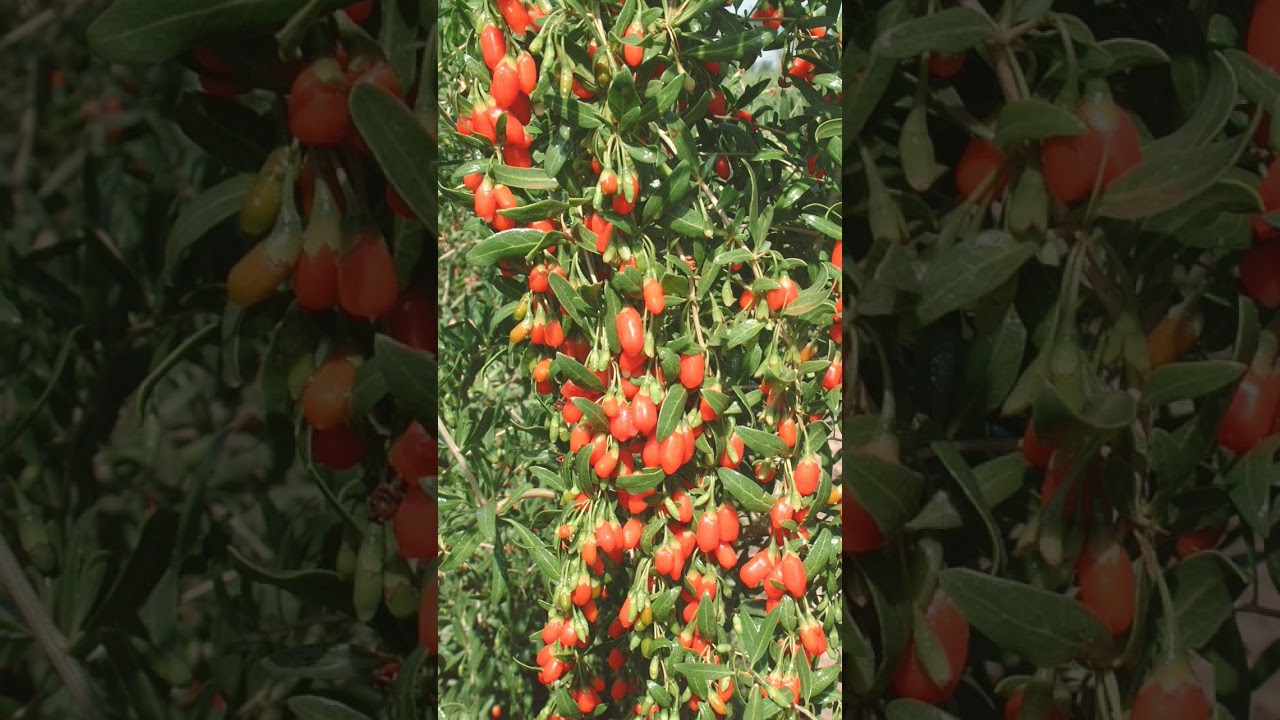
▪︎¹ (Lycium barbarum) Barbary Wolfberry: Most widely grown & commercially available species, primarily from China's Ningxia province. Its berries are typically bright Red, sweet & are 'Superior-grade' used in Traditional Chinese Medicine (TCM).
• Berry Color - Bright Orange-Red
• Fruit Taste - Sweeter
• Seeds - Small (approx. 2.5 mm²)
• Primary Use - Dried fruit (Superfood)
▪︎² (Lycium chinense) Chinese Wolfberry:
Often used for its leaves as a vegetable & for smaller, more tart berries. It is commonly found in southern China & other parts of East Asia like Japan & Korea.
• Berry Color - Orange-Red
• Fruit Taste - Less sweet/tart
• Seeds - Large (approx. 5 mm²)
• Primary Use - Leafy vegetable/Herbal tea
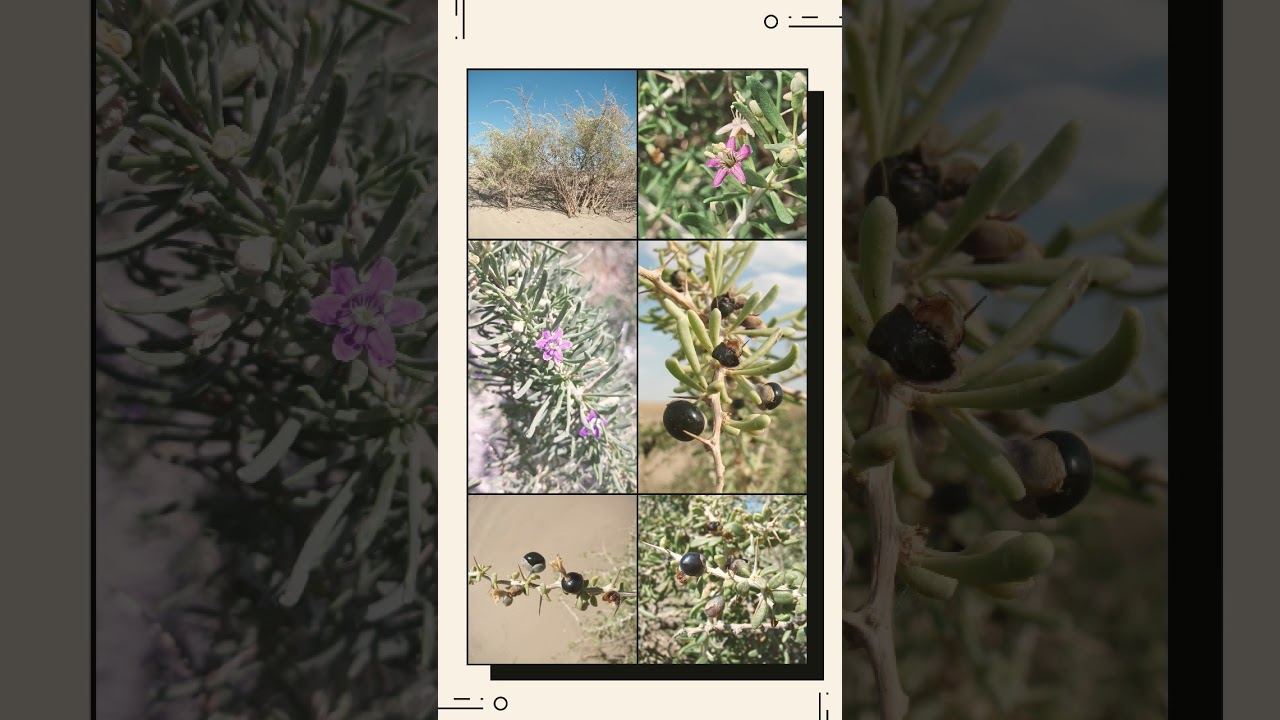
▪︎³ (Lycium ruthenicum) Black Goji Berry: Known as Russian Box-Thorn or Black Goji, this species produces deep Purple to Black berries. It is prized for its high content of anthocyanins, which provide potent antioxidant effects.
• Berry Color - Deep Black/Purple
• Fruit Taste - Sweet, tangy, pungent
• Seeds - Small
• Primary Use - High-antioxidant supplement
◇ Beyond primary 3, other regional species exist, many of which are wild or local ethnomedicine.
▪︎ Lycium europaeum: Native to Mediterranean region.
▪︎ Lycium americanum: Found in South America.
▪︎ Lycium shawii: Native to Africa.
▪︎ Lycium exsertum: A wild species found in desert Southwest of the United States.
▪︎ Lycium pallidum: Known as rabbit thorn, native to American Southwest & traditionally used by indigenous peoples.
___
🌻⁸☆ Order Solanales • 4938, 168, T²⁹
•⁴ Family Solanaceae • 2800, 101 - Nightshades
◇¹ Subfamily Cestroideae • 276, 10
◇² Subfamily Duckeodendroideae • 1, 1
◇³ Subfamily Goetzeoideae • 12, 7
◇⁴ Subfamily Nicotianoideae • 139, 8
◇⁵ Subfamily Petunioideae • 170, 11
◇⁶ Subfamily Schizanthoideae • 14, 1
◇⁷ Subfamily Solanoideae • 2188, 63
___
◇⁷ Subfamily Solanoideae • 2188, 63
■¹ Tribe Capsiceae • 184, 2
■² Tribe Datureae • 23, 3
■³ Tribe Hyoscyameae • 67, 9
■⁴ Tribe Jaboroseae • 23, 2
■⁵ Tribe Nicandreae • 3, 1
■⁶ Tribe Nolaneae • 184, 3
■⁷ Tribe Physalideae • 309, 29
■⁸ Tribe Salpichroeae • 19, 2
■⁹ Tribe Solandreae • 60, 10
■¹⁰ Tribe Solaneae • 1316, 2
-
■⁶ Tribe Nolaneae • 184, 3
▪︎ Genus Lycium • 101 - Honey-thorn Bushes
Nolana • 69
Sclerophylax • 14
___



Информация по комментариям в разработке