▪︎ Hingot हिंगोट, Hingor हिंगोर, Desert Date (Balanites roxburghii) in Caltrop Family (Zygophyllaceae) native to arid & semi-arid regions of India, Pakistan & Myanmar. Found throughout drier parts from Punjab to West Bengal, Rajasthan & Peninsular India.
Balanites from balanos 'acorn' was coined by French botanist Alire Delile in 1813 to describe shape & appearance of plant's fruit. Specific Epithet roxburghii honoring William Roxburgh (1751-1815), a Scottish surgeon & botanist. Roxburgh is often called 'Father of Indian Botany' for his extensive work while serving as Director of Calcutta Botanical Garden.
Desert Date • Hindi: हिंगोट Hingot, हिंगन hingan, हिंगन का पेड़ Hingan-ka-per, इंगुदी Ingudi, हिंगोर Hingor • Kannada: ಇಂಗಳ Ingala, ಇಂಗಳರಾಡ Ingalarada, ಇಂಗಳಾರ Ingalara • Malayalam: namunta, nanchunta • Marathi: Hingalbet, Hingam • Sanskrit: तापसद्रुमः Tapasadruma, Angaravrksa, हिंगुपत्र Hinguputra • Tamil: Nanchundan, Nancuntan • Telugu: Gara, Gara-chettu • Urdu: Hingot ﮨﹻﻨﮕﻮﭦ
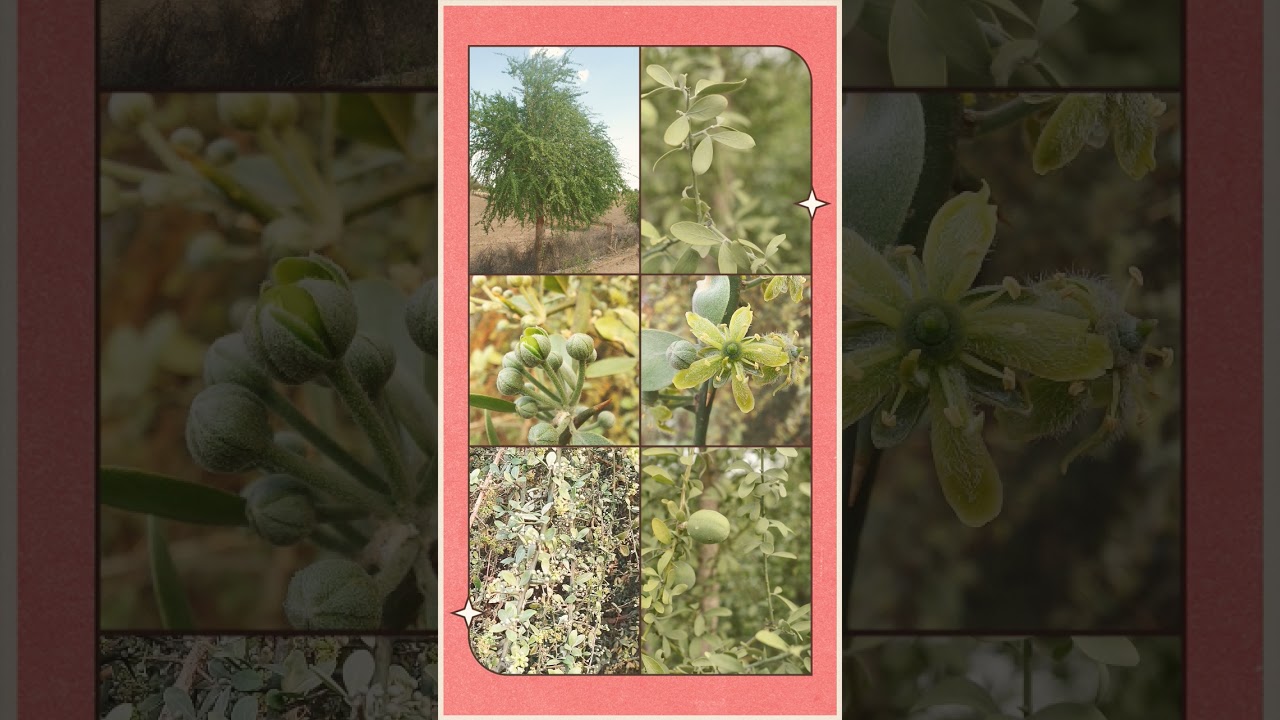
A small to medium-sized tree or shrub, typically reaching heights of 8-10 metres. It features a short trunk that often branches from near base, forming a spherical or narrow crown. Bark is Yellowish-Grey to dark Brown & deeply fissured.
Thorns: Branches are heavily armed with strong, sharp spines measuring 1-5 cm in length, which are often Greenish-Yellow & may bear leaves or flowers.
Leaves: Leaves are compound & distinctive for having 2 leathery leaflets (2-foliolate). Leaflets are elliptic or obovate, dark Green & pubescent (hairy) when young.
Flowers are arranged in axillary compact cymes or fascicles, typically containing 4-12 flowers per cluster. Flowers are actinomorphic (radially symmetrical), pentamerous (5-parted) & bisexual (hermaphroditic). Individual flowers measure approximately 8-14 mm in diameter. Flower Buds: Ovoid in shape & notably velvety or tomentose (covered in short, soft hairs).
● Calyx (Sepals): There are 5 coriaceous (leathery) Sepals that are densely pubescent on outside & bear long, silky Whitish hairs on inside.
● Corolla (Petals): There are 5 elliptic-oblong Petals, which are generally glabrous (smooth) on outside but silky hairy on inner surface.
● Androecium: Typically contains 10 Stamens arranged around a central disk.
● Gynoecium: Ovary is globose & rests on a prominent 10-grooved conical disk.
Fragrance: Flowers are noted for being fragrant.
Tree primarily flowers between December & May, peaking from March to May.
Is a specialized type of fleshy fruit known as a drupe. It is characterized by its woody structure, distinct layering & strong, often unpleasant odour. Fruits are typically ovoid, ellipsoid or subspherical. They measure approximately 5-6 cm in length & 3-4 cm in width. Surface is smooth to granular & often features 5-10 longitudinal grooves running from base to apex. Young fruits are Green & velvety (tomentose). As they mature, they turn Yellowish-Grey or pale Brown & become glabrous (smooth/hairless).
• Epicarp: Outermost layer is thin & brittle, often becoming easily fragmented when dry.
• Mesocarp: This is the fleshy pulp layer, which is sticky, dark Yellow & has a characteristically bitter-sweet taste & a foetid (offensive) smell.
• Endocarp (Stone): A very hard, woody & fibrous 'stone' that makes up 50-60% of fruit's weight. On shaking a dried fruit, endocarp can sometimes be heard rattling inside brittle shell.
Fruit contains a solitary seed (kernel) enclosed within hard endocarp. Seed is rich in oil (up to 45-60%) & is used for both medicinal & industrial purposes.
Ayurvedic & folk medicine
• bark & fruits - treat jaundice & liver or spleen disorders.
• Seed oil - burns, wounds & freckles. fruit rind - skin diseases like leucoderma.
• seeds & bark - purgative - abdominal colic, constipation & indigestion.
• Seed powder or fruit pulp - coughs, asthma, and bronchitis.
• Leaves ,& unripe fruits - anthelmintic - intestinal worms in both humans & livestock.
• anti-diabetic potential
___
🌹¹☆ Order Zygophyllales • 311, 31
•¹ Family Krameriaceae • 17, 1
•² Zygophyllaceae • 294, 30 - Creosote
___
•² Family Zygophyllaceae • 291, 26 - Caltrop
◇¹ Subfamily Balanitoideae • 69, 7
◇² Subfamily Larreoideae • 29, 8
◇³ Subfamily Morkillioideae • 4, 3
◇⁴ Subfamily Seetzenioideae • 1, 1
◇⁵ Subfamily Zygophylloideae • 188, 7
___
◇¹ Subfamily Balanitoideae • 69, 7
▪︎ Genus Balanites • 9 - Green Thorn Trees 🌼
Kallstroemia • 19
Kelleronia • 3
Neoluederitzia • 1
Sisyndite • 1
Tribulopis • 7
Tribulus • 29
___
◇² Subfamily Larreoideae • 29, 8
▪︎ Genus Bulnesia • 5
Gonopterodendron • 4
Guaiacum • 5
Larrea • 6
Metharme • 1
Pintoa • 1
Plectrocarpa • 2
Porlieria • 5
___
◇³ Subfamily Morkillioideae • 4, 3
▪︎ Genus Morkillia • 2
Sericodes • 1
Viscainoa • 1
___
◇⁴ Subfamily Seetzenioideae • 1, 1
▪︎ Genus Seetzenia • 1
___
◇⁵ Subfamily Zygophylloideae • 188, 7
▪︎ Genus Augea • 1
Fagonia • 36
Melocarpum • 2
Miltianthus • 1
Roepera • 60
Tetraena • 36
Zygophyllum • 52
___


Информация по комментариям в разработке