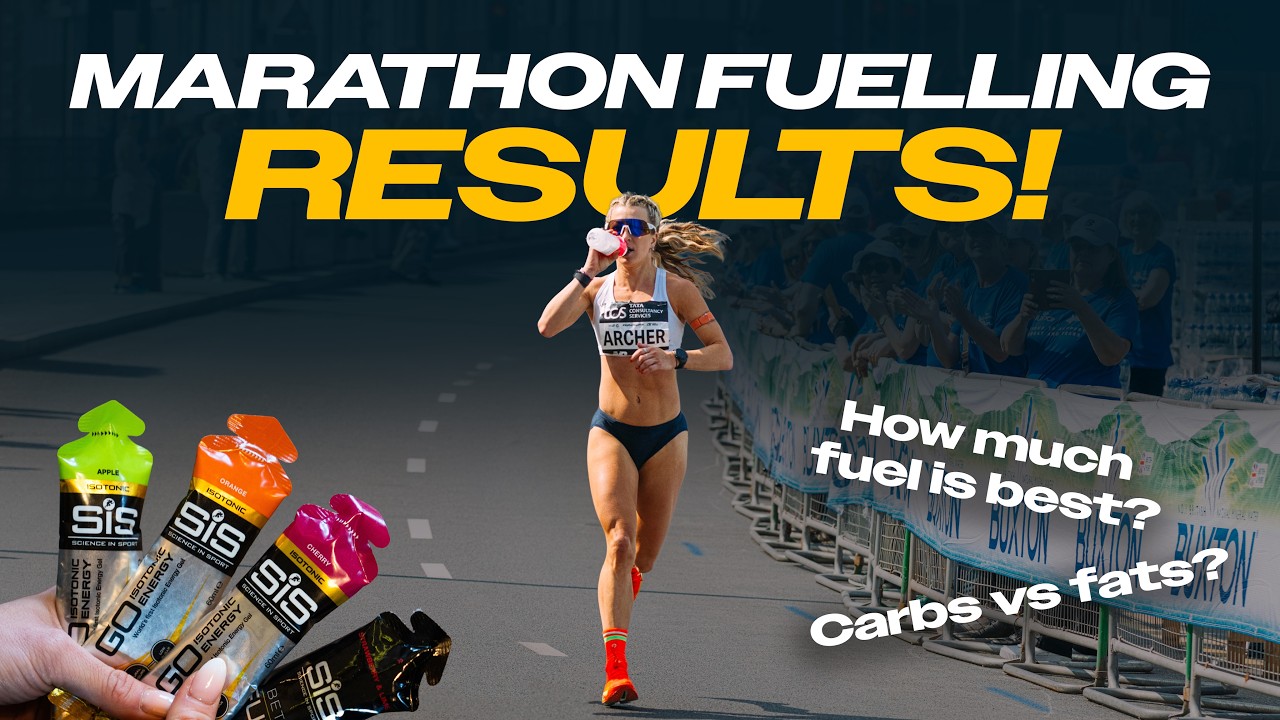
I’m really excited to share something properly educational with you all! I’ve been invited to take part in a groundbreaking research study with Liverpool John Moores University and Science in Sport (SIS), looking at the effect of carbohydrate ingestion during running.
Most carbohydrate studies in sport have been carried out on cyclists (because it’s easier to drink and measure fuel on a bike). But running is a completely different challenge, especially for the stomach! This is one of the first studies of its kind with elite marathon runners.
In this video, I’ll take you through my baseline testing, where we measured my lactate threshold to set training intensities and did a familiarisation run to understand the protocol. From here, I’ll be doing three experimental trials, each a 2-hour run, where the main 90-minute block will be at 95% of my lactate turn point (close to marathon pace).
During each trial:
I’ll take a carbohydrate drink every 15 minutes (either 60g, 90g, or 120g carbs per hour).
My heart rate, gas exchange, and blood lactate will be measured at set intervals.
Researchers will analyse whether my body is burning the carbs from the drink or relying more on stored glycogen.
The purpose? To better understand how runners, not just cyclists, can fuel most effectively during endurance events.
This video is Part 1, showing the baseline testing. In the next episodes, I’ll share the actual runs and what we discover.
If you’re a runner interested in fueling, performance, or marathon training, this is going to be a fascinating journey..please subscribe and let me know your questions.
🧪 Physiological Measurements
1. Heart rate (HR): recorded every 15 minutes.
2. Gas exchange / oxygen consumption (VO₂): measured using a mouthpiece + nose clip to see how much oxygen you’re using and how much CO₂ you’re producing.
3. Blood lactate: small finger-prick samples taken at 0, 15, 45, 75, 105, and 120 minutes.
4. Body mass: recorded before the trial.
💬 Subjective Measurements
5. Ratings of Perceived Exertion (RPE): how hard the run feels (every 15 minutes).
6. Gastrointestinal symptoms: bloating, nausea, cramps, etc. — rated using a validated scale.
7. Perceived satiety, sweetness, and desire to drink: using a Likert scale.
🥤 Nutrition Measurements
8. Carbohydrate ingestion: you’ll consume a drink every 15 minutes (150 mL), which always contains 15 g glucose plus either 0 g, 7.5 g, or 15 g fructose (so 60 g, 90 g, or 120 g carbs per hour).
9. Carbohydrate oxidation (how much you actually burn from the drink): measured via the isotopic markers (“particles”) in the carbohydrate drinks, which show whether you’re burning the carbs you ingested or your stored glycogen.
So in short: they’re tracking performance physiology (HR, VO₂, lactate), gut comfort, and how well my body uses the carbs i drink.



![Project Dove Go-the-Distance 2026 Virtual Marathon [To Walk]](https://i.ytimg.com/vi/sefAEbE3tsQ/maxresdefault.jpg)












Информация по комментариям в разработке